Isn't there any regulations that say that ALL electrical equipment that is around the animal enclosures have to be inspected on a monthly, or bi yearly basis? If not, there should be, if so, someone didn't do their job properly!
Gosh aren't the Chimpanzees safe anywhere in Captivity?
Story-
A fire broke out in Wellington Zoo's 'chimp cave' today, but no chimpanzees or humans were injured.
The Fire Service was called to the zoo shortly after 12pm, after smoke was reported coming from a heated shelter within the chimpanzee enclosure.
Fire officers put the fire out in less than a minute, the zoo said in a press release.
No animals, visitors or staff members were injured.
The chimps were reported to be "calmly relaxing inside for the afternoon".
The zoo said the cause of the fire would be investigated, but it initially appeared it was caused by an electrical fault with one of the pads that heats the shelter.
Source
Monday, January 18, 2010
Chimpanzees Live In Small Family Groupes, Are Aggressive And Often A Violent Society
'

As I See it Hal Sundin
As I See it Hal Sundin
Studies of our two closest primate relatives, chimpanzees and bonobos, suggest that he might be right. Chimpanzees are native across equatorial Africa as far east as Uganda. They live in small family units controlled by a dominant male. Theirs is an aggressive and often violent society. Succession is determined by conflict, and it has been found that infanticide is used by males in order to bring females into heat. Encounters with other chimpanzee groups are typically met with violence.
Bonobos, on the other hand, are a matriarchal society, living in extended families of related females. They are found only in the deepest jungles of central Democratic Republic of Congo (Zaire). Bonobos were not identified as a separate species until 1929, and had not been studied intensively until fairly recently because of the many decades of internal violence that dominated the region. What has recently been learned about bonbon society is extraordinary.
Bonbon communities are tranquil and loving, The female members of the group are close-knit and supportive of one another. Males are welcome members of the group, but do not dominate. Sexual activity is frequent and casual and largely serves to strengthen the bonds within the group. Relationships are cordial and every member sings out a good-night on retiring for the night. Matriarch succession takes place peacefully, and contacts with other family groups are welcome and cordial. It seems like a model society, from which we could possibly learn something. It is based on love, not violence. There seems to be a sense of empathy; mutual support within the group is strong, the young are loved and looked after by the community, and there is no animosity of aggressive feelings toward the other groups.
Now let's take a comparative look at our male-dominated society which glorifies wars and seems to be constantly creating reasons to engage in them. It's the testosterone-driven macho thing to do. Fathers who are veterans of wars are proud to have their sons go off to fight in the next one. Mothers see it quite differently. Too many fathers are interested only in creating children, and then neglect them instead of providing the family support and example needed to make their children productive members of society. All too many young men are overly absorbed in sports and booze, and have a caviler attitude toward education. As a result they fail to put forth the effort to acquire the skills needed to earn an income adequate to provide an education for their children. Increasingly women are having to take on that responsibility, and women now outnumber men in earning college degrees.
That being the case, why shouldn't we let women run the world? They certainly couldn't do a worse job than men have. There is no place in the world where women's influence is more needed than in those Muslim countries where they have virtually no voice. Educating and empowering women in those countries is very possibly the only way of ending Islamic terrorism.
— Glenwood Springs resident Hal Sundin's column runs every other Thursday in the Post Independent.
Source


Chromosome's Of Evolution
A new look at the human Y chromosome has overturned longstanding ideas about its evolutionary history. Far from being in a state of decay, the Y chromosome is the fastest-changing part of the human genome and is constantly renewing itself.
This is “a result as unexpected as it is stunning — truly amazing,” said Scott Hawley, a chromosome expert at the Stowers Institute in Kansas City, Mo. The Y chromosome makes its owner male because it carries the male-determining gene. Boys are born with one Y and one X chromosome in all their body’s cells, while girls have two X’s. The other 22 pairs of chromosomes in which the human genome is packaged are the same in both sexes.
The Y chromosome’s rapid rate of evolutionary change does not mean that men are evolving faster than women. But its furious innovation is likely to be having reverberations elsewhere in the human genome.
The finding was reported online on Wednesday in the journal Nature by a team led by Jennifer Hughes and David Page of the Whitehead Institute in Cambridge, Mass. In 2003, Dr. Page, working with scientists at the Washington University School of Medicine, decoded the DNA sequence of the human Y chromosome. He and the same Washington University genome team have now decoded the chimpanzee Y chromosome, providing for the first time a reference against which to assess the evolutionary history of the human Y.
The chimpanzee and human lineages shared a common ancestor just six million years ago, a short slice of evolutionary time. Over all, the genomes of the two species are very similar and differ in less than 1 percent of their DNA. But the Y chromosomes differ in 30 percent of their DNA, meaning that these chromosomes are changing far faster in both species than the rest of the genome.
In the case of chimps, their mating habits are probably the source of the fierce evolutionary pressure on their Y chromosome. When a female comes into heat, she mates with all the males in the group, setting up competition within her reproductive tract between the sperm of different males.
Many genes that govern sperm production are situated on the Y chromosome, and any genetic variation that improves a chimp’s chances of fatherhood will be favored and quickly spread through the population.
Sperm competition may have been important in the earliest humans, too, for some years after the chimp and human lineages split. Sperm competition could still play a role in human reproduction, some experts think, given the trickle of cases of heteropaternity, the birth of twins with different fathers.
Another reason for the intensity of selective pressures on the Y chromosome in both chimps and humans may be that natural selection sees it as a single unit, so a change in any one of its genes affects the survival of all the rest. On the other chromosomes, selection is more focused on individual genes because chunks of DNA are swapped between the members of each pair of chromosomes before the generation of eggs and sperm.
This DNA swapping process is forbidden between the X and the Y pair, keeping the male-determining gene from being transferred into the X chromosome, creating gender chaos.But this prohibition has caused most of the genes on the Y chromosome to decay for lack of fitness. In the rest of the genome, a gene damaged by a mutation can be swapped out for the good copy on the other chromosome.
In the Y, which originally had the same set of genes as the X, most of the X-related genes have disappeared over the last 200 million years. Until now, many biologists have assumed either that the Y chromosome was headed for eventual extinction, or that its evolutionary downslide was largely over and it has sunk into stagnation.
Dr. Page’s new finding is surprising because it shows that the Y chromosome has achieved an unexpected salvation. The hallmark of the Y chromosome now turns out to be renewal and reinvigoration, once the unnecessary burden of X-related genes has been shed.
“Natural selection is shaping the Y and keeping it vital to a degree that is really at odds with the idea of the last 50 years of a rotting Y chromosome,” Dr. Page said. “It is now clear that the Y chromosome is by far the most rapidly evolving part of the human and chimp genomes.”
This does not mean that men are evolving faster than women, given that the two belong to the same species, but it could be that the Y’s rate of change drives or influences the evolution of the rest of the human genome in ways that now need to be assessed. It would be “hard to imagine that these dramatic changes in the Y don’t have broader consequences,” Dr. Page said.
Andrew Clark, a geneticist who works on the Y chromosome at Cornell University, said the Y’s fast turnover of DNA could effect the activity of genes throughout the genome, because just such an effect has been detected in laboratory fruit flies.
The decoding of the Y chromosome’s DNA was particularly difficult because the chromosome is full of palindromes — runs of DNA that read the same backward as forward — and repetitive sequences that confuse the decoding systems. Decoding the human Y took 13 years, and the chimp Y took eight years, Dr. Page said.
Source
This is “a result as unexpected as it is stunning — truly amazing,” said Scott Hawley, a chromosome expert at the Stowers Institute in Kansas City, Mo. The Y chromosome makes its owner male because it carries the male-determining gene. Boys are born with one Y and one X chromosome in all their body’s cells, while girls have two X’s. The other 22 pairs of chromosomes in which the human genome is packaged are the same in both sexes.
The Y chromosome’s rapid rate of evolutionary change does not mean that men are evolving faster than women. But its furious innovation is likely to be having reverberations elsewhere in the human genome.
The finding was reported online on Wednesday in the journal Nature by a team led by Jennifer Hughes and David Page of the Whitehead Institute in Cambridge, Mass. In 2003, Dr. Page, working with scientists at the Washington University School of Medicine, decoded the DNA sequence of the human Y chromosome. He and the same Washington University genome team have now decoded the chimpanzee Y chromosome, providing for the first time a reference against which to assess the evolutionary history of the human Y.
The chimpanzee and human lineages shared a common ancestor just six million years ago, a short slice of evolutionary time. Over all, the genomes of the two species are very similar and differ in less than 1 percent of their DNA. But the Y chromosomes differ in 30 percent of their DNA, meaning that these chromosomes are changing far faster in both species than the rest of the genome.
In the case of chimps, their mating habits are probably the source of the fierce evolutionary pressure on their Y chromosome. When a female comes into heat, she mates with all the males in the group, setting up competition within her reproductive tract between the sperm of different males.
Many genes that govern sperm production are situated on the Y chromosome, and any genetic variation that improves a chimp’s chances of fatherhood will be favored and quickly spread through the population.
Sperm competition may have been important in the earliest humans, too, for some years after the chimp and human lineages split. Sperm competition could still play a role in human reproduction, some experts think, given the trickle of cases of heteropaternity, the birth of twins with different fathers.
Another reason for the intensity of selective pressures on the Y chromosome in both chimps and humans may be that natural selection sees it as a single unit, so a change in any one of its genes affects the survival of all the rest. On the other chromosomes, selection is more focused on individual genes because chunks of DNA are swapped between the members of each pair of chromosomes before the generation of eggs and sperm.
This DNA swapping process is forbidden between the X and the Y pair, keeping the male-determining gene from being transferred into the X chromosome, creating gender chaos.But this prohibition has caused most of the genes on the Y chromosome to decay for lack of fitness. In the rest of the genome, a gene damaged by a mutation can be swapped out for the good copy on the other chromosome.
In the Y, which originally had the same set of genes as the X, most of the X-related genes have disappeared over the last 200 million years. Until now, many biologists have assumed either that the Y chromosome was headed for eventual extinction, or that its evolutionary downslide was largely over and it has sunk into stagnation.
Dr. Page’s new finding is surprising because it shows that the Y chromosome has achieved an unexpected salvation. The hallmark of the Y chromosome now turns out to be renewal and reinvigoration, once the unnecessary burden of X-related genes has been shed.
“Natural selection is shaping the Y and keeping it vital to a degree that is really at odds with the idea of the last 50 years of a rotting Y chromosome,” Dr. Page said. “It is now clear that the Y chromosome is by far the most rapidly evolving part of the human and chimp genomes.”
This does not mean that men are evolving faster than women, given that the two belong to the same species, but it could be that the Y’s rate of change drives or influences the evolution of the rest of the human genome in ways that now need to be assessed. It would be “hard to imagine that these dramatic changes in the Y don’t have broader consequences,” Dr. Page said.
Andrew Clark, a geneticist who works on the Y chromosome at Cornell University, said the Y’s fast turnover of DNA could effect the activity of genes throughout the genome, because just such an effect has been detected in laboratory fruit flies.
The decoding of the Y chromosome’s DNA was particularly difficult because the chromosome is full of palindromes — runs of DNA that read the same backward as forward — and repetitive sequences that confuse the decoding systems. Decoding the human Y took 13 years, and the chimp Y took eight years, Dr. Page said.
Source
The Great Jane Goodall Giveaway

She didn’t know it at the time, but she was making history.
In those early years, it was unheard for animals in scientific arenas to be given names. Instead, they were assigned numbers because ‘they were just animals, after all’. Jane would hear none of it. The first chimpanzees she observed were then dubbed David Greybeard and Goliath. None of this number nonsense for Jane, she was on a path of discovery.
During her many years of observation, Jane witnessed what can only be described as world changing. Shortly after arriving in Gombe, Jane observed chimps eating meat. This shattered the myth that chimpanzees were vegetarian and opened the door to the real lives of these creatures that are not so unlike ourselves. She also observed acts of compassion and tool-making, traits which were previously seen as solely ‘human’. Chimps also routinely self-medicated with plants, passed on knowledge within a group and demonstrated planning for future events. One by one, Jane witnessed chimps doing the things we said only humans could do. In 1970, Jane also noted chimps performing a spontaneous dance-like display by waterfalls. Many believe that this exhibited expression of awe runs parallel to early forms of religion in humans.
What I mean to say is, by observing chimpanzees for what they really were, Jane challenged what it meant to be human.
Of course, the scientific community was not always happy about Jane’s findings. Einstein said that ‘great spirits have always found violent opposition from mediocre minds’. This was never truer than for Jane’s work. When it comes to declaring the great capacities of humans, we are easy to dole out the compliments. But when it comes to other species, we’re sometimes not so generous. Jane was ahead of her time, but she forged ahead, stated her case and continued her work.
For half a century, Jane has worked tirelessly for animals, conservation and people. She understands that to help the environment, we must also help people and vice versa. Thirty years after her adventures in Gombe, Dr. Goodall created Roots & Shoots, a humanitarian and environmental educational program for youth around the world. To date, the Roots & Shoots program is active in over 100 countries.
Dr. Jane Goodall is a testament to how influential one person can be in the course of history. She opened the door for others like myself to study animals, but have a heart while doing it. She exemplifies integrity, intelligence and compassion for all life. I had the pleasure of meeting Jane once – she oozes serenity and understanding. Her spirit is contagious and she holds nothing but hope for the future of our planet, despite the events we may see unfolding before us. In her eyes, you can see that she is an adventurer at heart.
Today, I’d like to honor Dr. Jane Goodall by having a little giveaway. Recently, I dropped by the Jane Goodall Institute in Toronto and bought some goodies. Along with many other organizations, the Jane Goodall Institute partners with African women through micro-enterprise loans. By supporting Ugandan Paper Bead Jewellery makers, we are giving them economic alternatives to selling bushmeat (chimpanzee meat) in the local markets.
I have one necklace (gorgeous, 3-strand purple beaded) and one bracelet (also 3-strand with black and irridescent beads). To spread the word of conservation and compassion I’d like to give them away! Because I love alliteration, I’m calling it the Great Goodall Giveaway (catchy, no?)
To enter, all you need to do is leave a comment here and answer the following question -
Which animal do you most relate to, and why?
To enter go here
Cosponsors of Chimpanzee Bill Urge Congress to Take Next Step
-

More than 1,000 chimpanzees languish in U.S. labs. HSUS
This critical legislation would end harmful research on chimpanzees, retire the approximately 500 federally owned chimpanzees to sanctuary, and make permanent the National Institute of Health's administrative ban on the breeding of chimpanzees for research purposes.
The bill could also save nearly $200 million in taxpayer dollars.
Widespread Support
On December 4, the sponsors of the bill—Reps. Edolphus Towns, D-N.Y., Dave Reichert, R-Wash., Jim Langevin, D-R.I., and Roscoe Bartlett, R-Md.—sent a letter on behalf of the bill's cosponsors to House Energy and Commerce Chairman Henry Waxman, D-Ca., and House Energy and Commerce Health Subcommittee Chairman Frank Pallone Jr., D-N.J. asking for a hearing on the Great Ape Protection Act.
Since the letter was sent, Congressional support for the bill has grown to over 130 cosponsors. Renowned backing primatologist Dr. Jane Goodall has also backed the bill. Dr. Goodall recently met with Chairman Waxman on Capitol Hill to express her support for the legislation.
Federally Funded
The letter highlights the fact that American taxpayers spend an estimated $25 million each year on chimpanzee maintenance and research, but approximately 90 percent of chimpanzees are not used in active experiments. Instead, they are wasting away in federally funded facilities—some for more than 50 years.
The letter also urges Congress to ensure that precious federal research dollars be invested wisely and used in methods that will more likely lead to effective treatments and cures for human illnesses.
Languishing in Laboratories
The opportunity to provide humane retirement for chimpanzees, coupled with the potential taxpayer savings, justifies the consideration of the Great Ape Protection Act.
"Many of these chimpanzees have been languishing in government facilities since the Eisenhower Administration. It is long past time to let our closest living relatives live out the rest of their lives in sanctuary far away from the barren laboratory cages where they are now stored," said Wayne Pacelle, president and CEO of The Humane Society of the United States.The use of chimpanzees in lab research has drastically declined in recent years due to past scientific failures, discovery of more practical alternatives, high financial costs, increased public outcry and ethical concerns. Yet, there are still approximately 1,000 chimpanzees currently living in seven laboratories in the United States. The U.S. is the only developed nation in the world that continues to use chimpanzees in harmful, invasive research.
Source
Dan Burke and The Humane Society Trying To Ban Primates, Monkeys and Apes, From Being Owned In Illinois
This is a very positive step in protecting our primates from being owned by people. If everyone would write to Rep. Dan Burke in Illinois, or to their state representative more people would want this bill to go through. More so than private owners objecting to it. Each state needs to change their laws, one by one, until all states have the law that it is illegal to own any type of Primate. Then hopefully the senate bill will go through!
At the top of this blog there is a link to each state's representative, where you can write to. I thank you in advance. Help us help the primates, they can't help themselves. All it takes is an e-mail.
Story-
That’s why one state lawmaker and the Humane Society of the United States want to ban Illinoisans from keeping primates as pets.
Legislation introduced this week would keep anyone in Illinois from owning a monkey or ape. The exceptions would be zoos, circuses and scientific labs.
The Humane Society argues that while monkeys and apes are cuddly when they’re young, they can grow up to be a handful. And they can carry diseases humans can also get, including Herpes B, salmonella, tuberculosis, and monkey pox.
“People don’t know how to take care of primates,” said Jordan Matyas, Illinois director of the Humane Society.
Ken Walker, an exotic-pet broker from Paxton, mostly agrees that a lot of people don’t know what they’re getting into when they think about getting a pet primate. But he says banning ownership is “ridiculous” and suggested some pet owners could protest the legislation.
“There are people out there who are qualified to work with them,” Walker said.
He suggested perhaps requiring disease testing of the primates. And Walker said anyone interested in owning them needs to educate themselves first.
He said some primates can live 40 years and bite later in their lives.
“I think it takes a special person to own them correctly,” Walker said.
The legislation was introduced by state Rep. Dan Burke, D-Chicago. It won’t be debated at least until February. Twenty other states ban primate ownership already.
“I’m convinced it’s a good public safety initiative,” said Burke.
Burke’s plan wouldn’t force people who already own primates to get rid of them. If the proposal is eventually approved, owners would have to register the animal with local authorities.
Republican U.S. Senate candidate Mark Kirk, a congressman from Highland Park, sponsored federal legislation last year that would bar people from moving a primate across state lines. The measure was approved by the U.S. House but has not become law.
Burke said he hopes to push his ban through this year.
“It’s up to me to persuade my colleagues that it’s serious,” Burke said.
The legislation is House Bill 4801.
Source
At the top of this blog there is a link to each state's representative, where you can write to. I thank you in advance. Help us help the primates, they can't help themselves. All it takes is an e-mail.
Story-
That’s why one state lawmaker and the Humane Society of the United States want to ban Illinoisans from keeping primates as pets.
Legislation introduced this week would keep anyone in Illinois from owning a monkey or ape. The exceptions would be zoos, circuses and scientific labs.
The Humane Society argues that while monkeys and apes are cuddly when they’re young, they can grow up to be a handful. And they can carry diseases humans can also get, including Herpes B, salmonella, tuberculosis, and monkey pox.
“People don’t know how to take care of primates,” said Jordan Matyas, Illinois director of the Humane Society.
Ken Walker, an exotic-pet broker from Paxton, mostly agrees that a lot of people don’t know what they’re getting into when they think about getting a pet primate. But he says banning ownership is “ridiculous” and suggested some pet owners could protest the legislation.
“There are people out there who are qualified to work with them,” Walker said.
He suggested perhaps requiring disease testing of the primates. And Walker said anyone interested in owning them needs to educate themselves first.
He said some primates can live 40 years and bite later in their lives.
“I think it takes a special person to own them correctly,” Walker said.
The legislation was introduced by state Rep. Dan Burke, D-Chicago. It won’t be debated at least until February. Twenty other states ban primate ownership already.
“I’m convinced it’s a good public safety initiative,” said Burke.
Burke’s plan wouldn’t force people who already own primates to get rid of them. If the proposal is eventually approved, owners would have to register the animal with local authorities.
Republican U.S. Senate candidate Mark Kirk, a congressman from Highland Park, sponsored federal legislation last year that would bar people from moving a primate across state lines. The measure was approved by the U.S. House but has not become law.
Burke said he hopes to push his ban through this year.
“It’s up to me to persuade my colleagues that it’s serious,” Burke said.
The legislation is House Bill 4801.
Source
Monkey Is Returned To A Child Owner
A quote- "He asked us over and over again as he knew more and more about them. And eventually we said, 'who are we to stop the next Jane, uh, John Goodall?'""
Well, everyone knows for a FACT that Jane Goodall would NEVER EVER own a primate to take away from it's mother, house him/her singly and not allow them to be a monkey, a primate, a wild animal.
Perhaps if they had done some research on Jane Goodall they may have felt different about their decision.
Story-
Oddly, the future of Rafiki, a tiny marmoset monkey who has lived nearly all of his eight years on Bainbridge Island with his adopted family, depends on a decision facing the Bainbridge Island City Council Wednesday evening.
The council will act on a resolution proposed by City Attorney Paul McMurray that would allow Rafiki to remain living with the Bainbridge family of Greg and Linda Stevenson.
Since July 2007, possession of the penicillata marmoset species and other primates has been illegal after state law defined them as "potentially dangerous wild animals," though RCW 16.30.010(2)(a)(iii) provides a "grandfather clause" that allows such domesticated animals to remain with their pet owners for the rest of their lives.
The Stevensons knew nothing about the new law until Rafiki, who was visiting Seattle last month with his best friend, University of Washington student Robert Stevenson, wandered away and eventually found himself in an isolation cell in the Seattle Animal Shelter.
Fortunately, Rafiki, who weighs less than a pound, was returned to Robert the next morning. But before he could come home to Bainbridge, which doesn't have an exception clause to the wild animal designation in its city code, the city had to agree to consider adopting a resolution that would allow the pet to live legally on the island.
In a letter that Robert – a junior majoring in bio-engineering at UW – wrote to the council 10 days ago requesting the change, he said, in part: "...it would be life threatening for him to be forced into a different setting. With your permission I would like to bring him with me to the pending council meeting. He will sit on my shoulder, wearing a leash and pants."
That's appropriate since the story of how the domestically bred (in Florida) Rafiki came to Bainbridge when only 7 weeks old centers on Robert's infatuation with primates.
"He was fascinated with them," said his mother, Linda. "But when he asked to get a monkey, of course his parents said, 'never in our house.' But starting in the sixth grade, he spent two years learning everything he could about them. He asked us over and over again as he knew more and more about them. And eventually we said, 'who are we to stop the next Jane, uh, John Goodall?'"
Before agreeing, they established several specific parameters, which essentially required him to be responsible for researching exactly what it would take to adopt and care for a primate.
"We were thinking he wouldn't follow through, but by the eighth grade he had all the stuff done, including the financial end of it," she said. "So then we looked into it and the more we did, the more I got hooked. And now we have a monkey. We love him."
She admits she wouldn't do it again, "because I'm a strong believer that this animal should not be a home pet," she said. "It's a lot for families to commit to, so I don't support it now. But he's a member of our family just like anyone else. He's a real fun character."
Marmosets, which generally can be found high in trees deep in the Brazilian rainforest, are extremely social and family oriented. Generally, their families are large and inseparable.
"He needs touching and attention all the time," Linda Stevenson said. "It's all about him. You could say he's a perpetual 2-year-old. He's very cuddly and protective of us."
He roams freely throughout the house and puts himself to bed, which is a large, open cage located in the family room.
The Stevensons nixed Robert's request to take Rafiki with him when he started college since his first residence was a fraternity house. But short visits have been allowed since he moved out of the frat. Unfortunately, Rafiki's last visit – to Robert's house for a couple of days – turned into a nightmare.
As Robert said: "...he was slightly disoriented being away from home and his family troop. He panicked and ran to a nearby apartment complex (in 20-degree weather), ending up later in the pound."
Rafiki was discovered by a nearby complex's maintenance man, who quickly became his friend and placed him in an empty apartment while calling the animal shelter.
"We were lucky," Linda Stevenson said. "He was in an obstinate mood and took off running while they were outside. It was a very cold day. He'd never done that before. His MO is to be around the family all the time. He has an outside cage at home where he comes and goes, and he likes to climb trees in the backyard. But never far from us. I guess he got confused."
She said the family is a little anxious about the city resolution, but she figures the council won't hesitate to approve it once members get a look at Rafiki.
"He's pretty lovable," she said.
Source and photograph
Well, everyone knows for a FACT that Jane Goodall would NEVER EVER own a primate to take away from it's mother, house him/her singly and not allow them to be a monkey, a primate, a wild animal.
Perhaps if they had done some research on Jane Goodall they may have felt different about their decision.
Story-
Oddly, the future of Rafiki, a tiny marmoset monkey who has lived nearly all of his eight years on Bainbridge Island with his adopted family, depends on a decision facing the Bainbridge Island City Council Wednesday evening.
The council will act on a resolution proposed by City Attorney Paul McMurray that would allow Rafiki to remain living with the Bainbridge family of Greg and Linda Stevenson.
Since July 2007, possession of the penicillata marmoset species and other primates has been illegal after state law defined them as "potentially dangerous wild animals," though RCW 16.30.010(2)(a)(iii) provides a "grandfather clause" that allows such domesticated animals to remain with their pet owners for the rest of their lives.
The Stevensons knew nothing about the new law until Rafiki, who was visiting Seattle last month with his best friend, University of Washington student Robert Stevenson, wandered away and eventually found himself in an isolation cell in the Seattle Animal Shelter.
Fortunately, Rafiki, who weighs less than a pound, was returned to Robert the next morning. But before he could come home to Bainbridge, which doesn't have an exception clause to the wild animal designation in its city code, the city had to agree to consider adopting a resolution that would allow the pet to live legally on the island.
In a letter that Robert – a junior majoring in bio-engineering at UW – wrote to the council 10 days ago requesting the change, he said, in part: "...it would be life threatening for him to be forced into a different setting. With your permission I would like to bring him with me to the pending council meeting. He will sit on my shoulder, wearing a leash and pants."
That's appropriate since the story of how the domestically bred (in Florida) Rafiki came to Bainbridge when only 7 weeks old centers on Robert's infatuation with primates.
"He was fascinated with them," said his mother, Linda. "But when he asked to get a monkey, of course his parents said, 'never in our house.' But starting in the sixth grade, he spent two years learning everything he could about them. He asked us over and over again as he knew more and more about them. And eventually we said, 'who are we to stop the next Jane, uh, John Goodall?'"
Before agreeing, they established several specific parameters, which essentially required him to be responsible for researching exactly what it would take to adopt and care for a primate.
"We were thinking he wouldn't follow through, but by the eighth grade he had all the stuff done, including the financial end of it," she said. "So then we looked into it and the more we did, the more I got hooked. And now we have a monkey. We love him."
She admits she wouldn't do it again, "because I'm a strong believer that this animal should not be a home pet," she said. "It's a lot for families to commit to, so I don't support it now. But he's a member of our family just like anyone else. He's a real fun character."
Marmosets, which generally can be found high in trees deep in the Brazilian rainforest, are extremely social and family oriented. Generally, their families are large and inseparable.
"He needs touching and attention all the time," Linda Stevenson said. "It's all about him. You could say he's a perpetual 2-year-old. He's very cuddly and protective of us."
He roams freely throughout the house and puts himself to bed, which is a large, open cage located in the family room.
The Stevensons nixed Robert's request to take Rafiki with him when he started college since his first residence was a fraternity house. But short visits have been allowed since he moved out of the frat. Unfortunately, Rafiki's last visit – to Robert's house for a couple of days – turned into a nightmare.
As Robert said: "...he was slightly disoriented being away from home and his family troop. He panicked and ran to a nearby apartment complex (in 20-degree weather), ending up later in the pound."
Rafiki was discovered by a nearby complex's maintenance man, who quickly became his friend and placed him in an empty apartment while calling the animal shelter.
"We were lucky," Linda Stevenson said. "He was in an obstinate mood and took off running while they were outside. It was a very cold day. He'd never done that before. His MO is to be around the family all the time. He has an outside cage at home where he comes and goes, and he likes to climb trees in the backyard. But never far from us. I guess he got confused."
She said the family is a little anxious about the city resolution, but she figures the council won't hesitate to approve it once members get a look at Rafiki.
"He's pretty lovable," she said.
Source and photograph
Sunday, January 17, 2010
Jeanne Rizzotto A "Former" Chimpanzee Owner?
Well according to this article with Jeanne Rizzotto's statements she still has Connor and Kramer The Chimpanzees. So which one is it Jeanne? Are you an owner or former owner? As she states "I have a great life," Rizzotto says. "I'm lucky enough to have two chimpanzees."
Read the most recent article here
2010 Winter TCA Tour - Day 6(Jeanne Rizzotto)

Former chimpanzee owner Jeanne Rizzotto, former chimpanzee owner Julie Burros, animal welfare policy expert Josephine Martell, and hepetologist Winston Card of "Fatal Attractions" speak during the Animal Planet portion of the 2010 Television Critics Association Press Tour at the Langham Hotel on January 14, 2010 in Pasadena, California.
(January 13, 2010 - Photo by Frederick M. Brown/Getty Images North America)
Source and more photographs
Source and more photographs
Jeanne Rizzotto, Wouldn't Know the Truth If One of Her Chimps Bit her on Her Nose
Please be sure to go to the links provided below in the comments to read about all of the bites that her Chimps have done. Also for more information you can "Google Her Name" on this blog for All articles.
Links on Bites:
Here
Here
Here
Story-
It was the worst example yet of wild animals vs. pet owners last year when Travis the chimpanzee a woman tried to domesticate in Stamford attached her friend and tore off her face.
And it's used in an example in the three-episode series coming to Animal Planet called "Fatal Attractions." Aside from the usual 911 tape and news footage, they otherwise turn to a Montana woman who owns a couple of chimps related to Travis.
"I'm happy I got the chimpanzees," Jeanne Rizzotto told an antagonistic group of critics at press tour. "I would do it all over again. I've been fortunate enough that I have not had an incident. The only thing I can take from other incidents that have happened is to just make a better environment for my chimps."
Rizzotto, who lives in Montana adds that "at this point, I do know that you should not have private ownership and I am working on things to find homes for chimpanzees with other sanctuaries. Right now all the sanctuaries are full. It is my belief, and I've done a complete turn-around that -- should people own chimpanzees? No. But right now in my situation, I just have to provide the best I can for my chimps and hopefully work with other people to get chimpanzees moved out of the home."Links on Bites:
Here
Here
Here
Story-
It was the worst example yet of wild animals vs. pet owners last year when Travis the chimpanzee a woman tried to domesticate in Stamford attached her friend and tore off her face.
And it's used in an example in the three-episode series coming to Animal Planet called "Fatal Attractions." Aside from the usual 911 tape and news footage, they otherwise turn to a Montana woman who owns a couple of chimps related to Travis.
"I'm happy I got the chimpanzees," Jeanne Rizzotto told an antagonistic group of critics at press tour. "I would do it all over again. I've been fortunate enough that I have not had an incident. The only thing I can take from other incidents that have happened is to just make a better environment for my chimps."
Though her own chimps are half brothers to the chimp shot in Stamford after the vicious attack, Rizzotto says, "I'm only aware of what happened with Travis just from television.
"It's unfortunate there are a lot of chimp owners that don't take care of their chimps and don't provide very good homes. But what I took from that is that I had the best people I could, experts, come to my home and assess my situation." And things had to change.
"Up until June, I will have to admit, my chimpanzees had their own bedrooms; they dressed in clothes. You know, in addition to the silly things I did to my chimps, they also were very bright. One plays golf and he has a little Hummer that he drives around in his enclosure.
But now, she says, "They no longer come in the home. They are in their own enclosures now. They don't wear clothes. You know, I don't do any of the cutesy stuff with them anymore. I'm trying the best I can to turn them back into chimpanzees."
Still, she has no regrets about being a chimp owner.
"I have a great life," Rizzotto says. "I'm lucky enough to have two chimpanzees. You know, it's hard to explain, but when you are sitting there at night and you do your two or three hours of working with them and trying to do the best you can and you are laying on a trampoline and you have a chimpanzee on each side of you and you are looking up and you are thinking, wow, this is really weird. I'm sure I'm the only person in the world that's laying on a trampoline with two chimpanzees."
Source
5 Comments
Ms Rizzotto is so full of BS
She is a SCAMMER of the first water, and only says or does whatever seems to be politically correct at the time.
She is an intelligent individual tho, and thats what makes her dangerous. Do a Google search for her name and you will find out about all of the people she has scammed.
From the Indian tribal council and people, to the LA Firefighters, and many private individuals including her own contractors and many many friends who invested in her balogney
She is a SCAMMER of the first water, and only says or does whatever seems to be politically correct at the time.
She is an intelligent individual tho, and thats what makes her dangerous. Do a Google search for her name and you will find out about all of the people she has scammed.
From the Indian tribal council and people, to the LA Firefighters, and many private individuals including her own contractors and many many friends who invested in her balogney
"I'm happy I got the chimpanzees," Jeanne Rizzotto told an antagonistic group of critics at press tour. "I would do it all over again. I've been fortunate enough that I have not had an incident.
This statement is a BALD FACED LIE.
She has had a number of incidents involving BITES to neighbors and caretakers and visitors to her home.
So many that the authorities are all over her to contain and get rid of the chimps.
She continues to fail to comply with their regulation attempts as tho the law does not apply to her.
This statement is a BALD FACED LIE.
She has had a number of incidents involving BITES to neighbors and caretakers and visitors to her home.
So many that the authorities are all over her to contain and get rid of the chimps.
She continues to fail to comply with their regulation attempts as tho the law does not apply to her.
ron is correct, ms. rizzotto is a scam artist. she is a scary individual who is out for whatever money she can make, even at the expense of Native Americans, business owners, her own son. i believe at one point she was sued for issuing a large bad check to the animal preserve that her chimps came from.
someone went to her home last year and released the chimps, and one of them bit someone. i wonder if they will talk about that in the special? she should be exposed for the fraud, fraud, fraud that she is. just look up how many times she's been taken to court in the last two years and you'll see what i mean. in my opinion, she may have done this animal planet show just for the money. there has to be a zoo somewhere that would take her chimps.
here are some news articles describing her character:
http://www.hotel-online.com/News/PR2009_2nd/Apr09_JRizzotto.html
http://www.gallupindependent.com/2008/09september/091908rizzotto.html
http://www.gallupindependent.com/2008/09september/091808developer.html
boycott this show in protest of ms. rizzotto until she pays back the Native Americans, contractors, family, everyone that she's scammed.
someone went to her home last year and released the chimps, and one of them bit someone. i wonder if they will talk about that in the special? she should be exposed for the fraud, fraud, fraud that she is. just look up how many times she's been taken to court in the last two years and you'll see what i mean. in my opinion, she may have done this animal planet show just for the money. there has to be a zoo somewhere that would take her chimps.
here are some news articles describing her character:
http://www.hotel-online.com/News/PR2009_2nd/Apr09_JRizzotto.html
http://www.gallupindependent.com/2008/09september/091908rizzotto.html
http://www.gallupindependent.com/2008/09september/091808developer.html
boycott this show in protest of ms. rizzotto until she pays back the Native Americans, contractors, family, everyone that she's scammed.
Ms Rizzotto seems a bit conflicted. On one hand she does not believe that people should be permitted to own chimps, and on the other she is happy she got hers and would do it all over again. Sounds like a case of "I can do it but no one else can."
In a previous press release Jeanne Rizzotto was quoted as saying that" she acquired her chimps under false pretense" which is a lie.
She bought her chimps as babies and they were never in any danger or need of rescue.
Ms Rizzotto seems to have trouble making up her mind. On one hand she says it is wrong for private owners to have chimpanzees
and on the other she says she is happy she got hers and would do it all over again.
See
Tuesday, January 12, 2010
Help All Chimpanzees By Writing To Senator Cantwell About The Great Ape Portection Act and the USDA To Enforce Animal Welfare!
Ask Senator Maria Cantwell to support the Great Ape Protection Act
Please contact Senator Maria Cantwell, and ask her to show her support of the Great Ape Protection Act, H.R. 1326, by leading on a Senate version of the bill.
Thanks to supporters like you across the country, the bill – currently in the House Energy and Commerce Committee – has over 120 cosponsors to date. Your voice as a constituent is key to the bill’s success.
Suggested email text: Dear Senator Cantwell,
As your constituent, I am writing to ask for your leadership on a Senate version of the Great Ape Protection Act (H.R. 1326). This legislation will end invasive research on chimpanzees, retire all federally-owned chimpanzees to sanctuary, and codify NIH’s administrative ban on federal funding for breeding chimpanzees.
About 1,000 chimpanzees live at great tax payer expense in eight labs. The vast majority are not in active research, but instead are languishing in these facilities. Chimpanzees are extremely expensive to maintain in a lab. A full 71% of the American public believes that those who have spent 10 years or more should be retired to sanctuary. It is estimated that nearly $200 million taxpayer dollars will be saved through this legislation as it phases out of the use of chimpanzees in invasive research and transfers them to sanctuary retirement, including our federal chimpanzee sanctuary.
The Great Ape Protection Act is a long over-due, common-sense reform that will: protect our closest genetic relatives from physical and psychological harm; stop the fleecing of American taxpayers who pay for their substandard laboratory maintenance and care; and allow precious NIH dollars to be reallocated to more productive areas of research that can truly benefit humans. This issue is very important to me. I would be very grateful for your leadership on this critical legislation. Thank you
The Great Ape Protection Act Prohibits:
> Invasive research on great apes
> Federal funding of such research both within and outside of the U.S.
> Transport of great apes for such research
> Federal breeding of great apes for such research
Requires:
> Permanent retirement of all federally-owned great apes to sanctuary
——————–
Tell The USDA They Must Enforce The Animal Welfare Act
Elephant advocates around the world were disappointed with a pre-New Year court decision that dismissed, on technical grounds, a federal lawsuit against Feld Entertainment/Ringling Bros. and Barnum & Bailey Circus.
However disappointing, this decision can in no way be seen as a victory for Ringling or any other circus that enslaves and exploits elephants. Judge Emmett Sullivan’s 57-page decision never addressed the merits of the case, or the mountain of irrefutable evidence that Ringling’s routine confinement, beating and chaining of elephants violates the U.S. Endangered Species Act.
contact the Deputy Administrator of USDA’s Animal Care, and urge that the agency fulfill its obligation under federal law to safeguard the welfare of these elephants by enforcing the Animal Welfare Act.
http://tinyurl.com/yej8gzq
Chester A. Gipson, D.V.M.
Deputy Administrator, USDA-APHIS-AC
4700 River Rd., Unit 97, Riverdale, MD 20737-1234
301-734-7833 (phone)
301-734-4993 (fax)
chester.a.gipson@usda.gov
Source
———————
Please contact Senator Maria Cantwell, and ask her to show her support of the Great Ape Protection Act, H.R. 1326, by leading on a Senate version of the bill.
Thanks to supporters like you across the country, the bill – currently in the House Energy and Commerce Committee – has over 120 cosponsors to date. Your voice as a constituent is key to the bill’s success.
Suggested email text: Dear Senator Cantwell,
As your constituent, I am writing to ask for your leadership on a Senate version of the Great Ape Protection Act (H.R. 1326). This legislation will end invasive research on chimpanzees, retire all federally-owned chimpanzees to sanctuary, and codify NIH’s administrative ban on federal funding for breeding chimpanzees.
About 1,000 chimpanzees live at great tax payer expense in eight labs. The vast majority are not in active research, but instead are languishing in these facilities. Chimpanzees are extremely expensive to maintain in a lab. A full 71% of the American public believes that those who have spent 10 years or more should be retired to sanctuary. It is estimated that nearly $200 million taxpayer dollars will be saved through this legislation as it phases out of the use of chimpanzees in invasive research and transfers them to sanctuary retirement, including our federal chimpanzee sanctuary.
The Great Ape Protection Act is a long over-due, common-sense reform that will: protect our closest genetic relatives from physical and psychological harm; stop the fleecing of American taxpayers who pay for their substandard laboratory maintenance and care; and allow precious NIH dollars to be reallocated to more productive areas of research that can truly benefit humans. This issue is very important to me. I would be very grateful for your leadership on this critical legislation. Thank you
The Great Ape Protection Act Prohibits:
> Invasive research on great apes
> Federal funding of such research both within and outside of the U.S.
> Transport of great apes for such research
> Federal breeding of great apes for such research
Requires:
> Permanent retirement of all federally-owned great apes to sanctuary
——————–
Tell The USDA They Must Enforce The Animal Welfare Act
Elephant advocates around the world were disappointed with a pre-New Year court decision that dismissed, on technical grounds, a federal lawsuit against Feld Entertainment/Ringling Bros. and Barnum & Bailey Circus.
However disappointing, this decision can in no way be seen as a victory for Ringling or any other circus that enslaves and exploits elephants. Judge Emmett Sullivan’s 57-page decision never addressed the merits of the case, or the mountain of irrefutable evidence that Ringling’s routine confinement, beating and chaining of elephants violates the U.S. Endangered Species Act.
contact the Deputy Administrator of USDA’s Animal Care, and urge that the agency fulfill its obligation under federal law to safeguard the welfare of these elephants by enforcing the Animal Welfare Act.
http://tinyurl.com/yej8gzq
Chester A. Gipson, D.V.M.
Deputy Administrator, USDA-APHIS-AC
4700 River Rd., Unit 97, Riverdale, MD 20737-1234
301-734-7833 (phone)
301-734-4993 (fax)
chester.a.gipson@usda.gov
Source
———————
Bush Meat Has to Stop to Save The Chimpanzees
Chimpanzees in Africa face a grim reality. Their numbers have dwindled 75% over the last 30 years because of habitat loss and the illegal ape meat trade. Veterinarian Sheri Speede is dedicating her life to helping these primates. She moved from Oregon to Cameroon over ten years ago. At first she went to offer veterinary services but decided to open a chimpanzee rescue center after forming relationships with several adult chimpanzees in captivity.
The Sanaga-Yong Chimpanzee rescue center currently houses 66 chimpanzees that range in age from two to over 40 years. The chimpanzees live in family groups. There are five enclosure complexes. All include large tracts of forest. Speede is also the president and founder of In Defense of Animals Africa. She has started a campaign to end the ape meat trade.
For more information about the center and how you can help visit: www.ida-africa.org.
A very sad video .................
Source and video
The Sanaga-Yong Chimpanzee rescue center currently houses 66 chimpanzees that range in age from two to over 40 years. The chimpanzees live in family groups. There are five enclosure complexes. All include large tracts of forest. Speede is also the president and founder of In Defense of Animals Africa. She has started a campaign to end the ape meat trade.
For more information about the center and how you can help visit: www.ida-africa.org.
A very sad video .................
Source and video
Charla Nash's updates
Let's never forget the brave woman, Charla Nash, her daughter for her support and Charla's wonderful brothers. You can read about Charla, her progress and what she is doing. This is a woman that should never be forgotten!
Charla's Website
Charla's Website
Brandon a 9YO Boy Speaks Out For The Chimpanzees
Here is a blog that a 9 year old boy by the name of Brandon has started to give awareness and asking for help for the Chimpanzees. Brandon has touched my heart, he's so young though understands the horrible plight of Chimpanzees in all aspects. I hope he continues his awareness and love so that perhaps some day he also can do something Great for them. Good work Brandon, Kudos to you for having a good heart for the Chimpanzees.
Make a chimp smile! Save The Chimps! Great name for a blog.
Website
Make a chimp smile! Save The Chimps! Great name for a blog.
Website
Are Zoo's A Prison?

Photo via flickr
Jimmy is a 26 year old chimpanzee who has spent several years alone in a cage, where he's on exhibit at a zoo in Niterói, Brazil, just outside of Rio de Janeiro. Just last week, animal protection groups filed a motion to have Jimmy released on grounds of Habeas Corpus, arguing that he is being denied his rights to freedom of movement and to a decent life, in Rio's Criminal Court. If the appeal is accepted and Jimmy is allowed to go free, it will not be the first time such a legal maneuver is successful, however. Slowly, courts around the country are beginning to consider chimpanzees like Jimmy a legal 'party' with rights and not merely objects.
The argument put forth by the Great Ape Project and other prosecutors and lawyers on behalf of Jimmy is grounded in Brazil's Constitution which states:
The right to habeas corpus is granted whenever someone suffers or feels threatened by violence or coercion in their freedom of movement by illegality or abuse of power.Habeas Corpus Has Worked Before
In 2005, another captive chimpanzee in the country was supposed to be released when a similar petition was filed in Bahia. Brazilian prosecutor Heron Santana led the case which has become a global standard. Together with professors and law students associations and animal rights, he filed a Habeas Corpus in favor of a 23 year old chimpanzee named Switzerland, who was in zoo for 4 years, according to a report in Jornal a Tribuna.
Sadly, the day after the ruling was delivered granting Switzerland her freedom, she was found dead in her cage.
Because of the precedent set in Switzerland's case, animal rights groups are hopeful that Jimmy will be granted his freedom as well. There's no telling, though, whether other courts around the world will begin to consider chimpanzees, our closest genetic cousins, creatures deserving of the most fundamental of legal rights--or whether they'll remain viewed as mere objects.
More on Animal Rights Cases
Bowoto v Chevron Human Rights Case Could Set Legal Precedent With Environmental Applicability
California Voters Say Yes to Animal Rights
Swiss Government Issues Bill of Rights for Plants
Source
Evolution
Human Evolution 101
In this series I hope to point out the specific areas which show that Humans evolved. In this I will be covering the fossil record, showing that humans evolved from a common ancestor with chimps.As pointed out earlier, there are a number of fossils which show Evolution between humans and our last common ancestor with chimps.
Here we see a number of fossils from the hominins. Names are below:
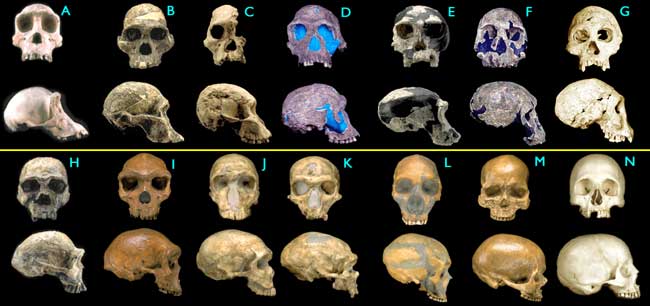
* (A) Pan troglodytes, chimpanzee, modern
* (B) Australopithecus africanus, STS 5, 2.6 My
* (C) Australopithecus africanus, STS 71, 2.5 My
* (D) Homo habilis, KNM-ER 1813, 1.9 My
* (E) Homo habilis, OH24, 1.8 My
* (F) Homo rudolfensis, KNM-ER 1470, 1.8 My
* (G) Homo erectus, Dmanisi cranium D2700, 1.75 My
* (H) Homo ergaster (early H. erectus), KNM-ER 3733, 1.75 My
* (I) Homo heidelbergensis, "Rhodesia man," 300,000 - 125,000 y
* (J) Homo sapiens neanderthalensis, La Ferrassie 1, 70,000 y
* (K) Homo sapiens neanderthalensis, La Chappelle-aux-Saints, 60,000 y
* (L) Homo sapiens neanderthalensis, Le Moustier, 45,000 y
* (M) Homo sapiens sapiens, Cro-Magnon I, 30,000 y
* (N) Homo sapiens sapiens, modern
Notice how they start to look like us as we go forward in time? The increase in brain size also confirms this.

The picture includes the relevant study as well.
Now we know that all ardipithecines, australopithecines and the ones from the genus homo are bipedal. This can be deduced from the fact that the structure of bone in their femur shows the cancellous bone to be adapted for bipedal walking according to Wolff's Law. Another piece of evidence is the foramen magnum. In all of these fossils, the foramen magnum is more vertical than chimps, highlighting that these are bipedal animals.
For more information on the subject of bipedalism read these papers:
Crompton, R.H., Vereecke, E.E. & Thorpe, S.K.S., 2008, Locomotion and posture from the common hominoid ancestor to fully modern hominins, with special reference
to the last common panin/hominin ancestor, Journal of Anatomy, 212: 501–543
Harcourt-Smith, W.E.H. & Aiello, L.C., 2004, Fossils, feet and the evolution of human bipedal locomotion, Journal of Anatomy: 204, 403-416
Richmond, B.G., Aiello, L.C. & Wood, B.A., 2002, Early Hominin Limb Proportions, Journal of Human Evolution, 43, 529–548
Rodman, P.S. & McHenry, H.M., 1980, Bioenergetics and the Origin of Hominid Bipedalism, American Journal of Physical Anthropology 52:103- 106
Stanford, C.B., 2006, Arboreal Bipedalism in Wild Chimpanzees: Implications
for the Evolution of Hominid Posture and Locomotion, American Journal Of Physical Anthropology 129:225–23
Steudal-Numbers, K.L., 2006, Energetics in Homo erectus and other early hominins: The consequences of increased lower-limb length, Journal of Human Evolution, 51: 445-453
Furthermore, for more papers which show the evolution of humans from a common ancestor with chimps read:
Bastir, M., O’Higgins, P., Rosas, A., 2007, Facial ontogeny in Neanderthals and
modern humans, Proceedings of the Royal Society B; 274, 1125–1132
Cobb, S., 2008, The facial skeleton of the chimpanzee-human last common ancestor, Journal of Anatomy, 212: 469–485
Dean, C., 2006, Tooth microstructure tracks the pace of human life history evolution, Proceedings of the Royal Society B, 22;273(1603):2799-808.
Lewin, 1999, Human Evolution: An Illustrated Introduction, Blackwell Science, UK
Lucas, P.W., Constantino, P.J. & Wood, B., 2008, Inferences regarding the diet of extinct hominins: structural and functional trends in dental and mandibular morphology within the hominin clade, Journal of Anatomy, 212: 486–500
Sherwood, C.C., Subiaul, F. & Zawidzki, T.W., 2008, A natural history of the human mind: tracing evolutionary changes in brain and cognition, Journal of Anatomy, 212: 426–454
Tocheri, M.W., Orr, C.M., Jacofsky, M.C. & Marzke, M.W., 2008, The evolutionary history of the hominin hand since the last common ancestor of Pan and Homo, Journal of Anatomy, 212: 544–562
Wood, B. & Richmond, B.G., 2000, Human Evolution: Taxonomy and palaeobiology, Journal of Anatomy, 196, 19-60
Wood, B. & Lonergan, N., 2008, The hominin fossil record: taxa, grades and clades, Journal of Anatomy, 212: 354–376
Wynn, T., 2002, Archaeology and cognitive evolution, Behavioural and Brain Sciences 25, 3: 389-402
If human evolution is false then we would not see links between these species, which we do as I have many more papers which also detailed the cognitive evolution, showing how society has evolved in co-existence with the physical evolution of humans.
Another conundrum which Evolution solved is Lucy's hand. Chimps and gorillas have a feature in their wrist which allows them to do a form of quadrapedal walking called knuckle walking. It locks the wrist so that it cannot bend back like ours can, evidenced by Smith fractures. Now somewhere, we have lost that trait in our ancestry. Strait, et al, in an anatomical examination of Lucy the Australopithecine, found that these hominins have it whilst later ones such as Homo erectus do not!
Paper is here
This provides proof that this species is not a chimp nor humans as it is bipedal and has a feature only found in other Great Apes excluding ourselves!
Furthermore, if Evolution was false, we would not find this transition in the fossil record. Instead of this gradual increase in brain size, etc, we would see fossils like Homo erectus in the wrong place, a typical "Precambrian Rabbit problem." This shows that the fossil record supports Human Evolution.
Source
Right Hand, Left Brain: Chimpanzee Communication

(Images via: Free Webs, Answers, ISS)
Chimpanzees predominantly signal with their right hands, yet again showing that they are like humans, according to a recent study. Just as we communicate by using the left side of our brains, chimpanzees apparently do the same, based on a 10-month study of chimpanzee hand use. According to the study’s researchers, these findings once again suggest that human speech evolved from gestures used by these ancestors.


Source and information on other animals
Monday, January 11, 2010
9 YO Male Orangutan Rescued After Falling In Moat At Prague Zoo
Thank Goodness Denise Ryšková was there to save him along with Zdeněk Loužil. What a great act of love and kindness.
I have to wonder why this enclosure was not built and maintained well enough to prevent something like this from happening.
Story-
On Thursday 7th January, 'Pagy', an adventurous nine year old male Orangutan in Prague Zoo embarked upon a round of enclosure exploration of his 'Indonesian Jungle Pavilion' home.
Climbing along ropes and branches without a problem he became encouraged and made an attempt to explore further. An attempt to climb and swing upon some palm foliage ended in disaster as it gave way causing the unfortunate animal to fall into the deepest part of the water filled moat below.
Pagy

Photo By Zoo Praha
Without a moments hesitation the brave keeper Denise Ryšková jumped into the water to rescue him. She was quickly assisted by a pavilion gardener, Zdeněk Loužil, and between them they managed to pull the animal out of the water. He appeared in a bad way but was immediately placed into the recovery position and then aid administered. He coughed up a large amount of water and quickly showed improvement and struggled to his feet.
Pagy was then persuaded into an off show area where he could be dried off and given veterinary supervision.
Credit is due to his two noble rescuers.
Source
Primates Use Caves To Escape The Heat
Chimpanzees in a West African republic of Senegal take preserve from a boiling feverishness in caves, researchers
have found.
The find has lifted gibberish between monkey researchers, who contend it's a initial well well well known box of unchanging cavern have make have make have make have make make make make make make use of of of of of of of of of of of of of by an ape species.
The surprising function is shown by a same chimpanzees not long ago found to track tiny mammals regulating sensory sticks.
Jill Pruetz, an anthropologist during Iowa State University, led a investigate group during a back of a brand brand brand new discoveries. Hers is a initial long-term observational investigate of a savanna-dwelling chimpanzee population.
Pruetz pronounced which when she began fieldwork in 2001, during a site well well well known as Fongoli, internal Malinke people showed her a caves as well as told her they were mostly assigned by chimpanzees during a hottest partial of a year.
She was intrigued by a claim, though watching a chimpanzee function valid difficult.
"It took years as well as years for a chimpanzees to get hooked [to a researchers' presence]," Pruetz said. "As shortly as you would travel anywhere close, it would shock them out of a caves."
Even with couple of approach observations, Pruetz's group was means to consider a border of cavern have make have make have make have make make make make make make use of of of of of of of of of of of of of regulating clues left during a back of upon sandy cavern floors: tracks, droppings, as well as food remains.
The investigate showed which cavern have make have make have make have make make make make make make use of of of of of of of of of of of of of was strong during a finish of a dry deteriorate in May as well as June.
"The function appears to be an composition to feverishness stress," Pruetz said.
"No a single has ever prior to published reports of apes in caves," remarkable William McGrew of Cambridge University in England.
"This is a single of those cases in which a apes honestly warn us, surpassing a expectations as well as imaginations."
Pruetz's paper upon cavern have make have make have make have make make make make make make use of of of of of of of of of of of of of by a Fongoli chimpanzees will be published in a stirring emanate of a biography Primates.
Dry Country Apes
Much of what is well well well known about furious chimpanzee function comes from studies conducted in forests.
But in Senegal chimpanzees take up dull savanna medium dominated by open grassland as well as meagre woodland. Chimpanzees in these areas vaunt a operation of behaviors not found elsewhere.
Pruetz remarkable which cavern have make have make have make have make make make make make make use of of of of of of of of of of of of of is only a single of multiform strategies a chimpanzees have make have make have make have make make make make make make use of of of of of of of of of of of of of to cope with their formidable environment, where both shade as well as H2O have been vicious resources.
In Apr as well as May limit temperatures in open grassland circuitously a caves can strech 107.6 degrees Fahrenheit (42 degrees Celsius). Temperatures in a largest of a 3 tiny caves used by a chimpanzees never exceeded 84.2 degrees Fahrenheit (29 degrees Celsius).
Lack of a circuitously H2O source progressing in a dry deteriorate might have prevented a caves from being used some-more during length via a year.
Pruetz pronounced which whilst her brand brand brand new paper is formed only upon interpretation picked up during a Fongoli investigate site, her group has additionally celebrated cavern have make have make have make have make make make make make make use of of of of of of of of of of of of of in alternative circuitously chimpanzee populations.
At a place called Baniomba, she said, "[chimpanzees] appear to have make have make have make have make make make make make make use of of of of of of of of of of of of of caves even some-more than during Fongoli. But you don't nonetheless have any a single after another data."
Pruetz's connoisseur tyro Peter Stirling reported which a deeper Baniomba caves appeared to be assigned upon a every day basement over a two-week duration in a summer.
"It's roughly identical to they're regulating a caves there as a home base," Pruetz said.
Give Me Shelter
The adaptations of savanna chimpanzees have been quite engaging to researchers since early humans have been suspicion to have assigned identical environments.
"The anticipating would be important in itself, though a implications for reconstructing a evolutionary origins of preserve in a ancestors have it even some-more so," pronounced Cambridge's McGrew.
Some monkeys have make have make have make have make make make make make make use of of of of of of of of of of of of of caves to stay comfortable during night, he noted. What is appealing about a brand brand brand new investigate is which it shows "not a nightly have make have make have make have make make make make make make use of of of of of of of of of of of of of of caves for overnight sleeping though rsther than [daytime use] for siestas, socializing, as well as picnicking. No a single approaching this."
University of California San Diego anthropologist Jim Moore pronounced which whilst cavern have make have make have make have make make make make make make use of of of of of of of of of of of of of might appear to be an viewable plan for avoiding a midday sun, a function documented by Pruetz's group is unusual.
"Primates really mostly don't have make have make have make have make make make make make make use of of of of of of of of of of of of of accessible shelter, even to get out of a rain," Moore said.
"The anticipating opens up a total set of questions, since which this function isn't seen in alternative regions of Africa," he continued.
"Are they right during a corner of what chimpanzees can hoop in conditions of heat … or is it a informative thing?"
Long-term studies of timberland chimpanzee populations have shown which "historical as well as fine-scale ecological differences can outcome in really opposite cultures," Moore noted.
"There have been a series of attempts to investigate savanna chimpanzees," he said, "but [Pruetz's study] is a initial to get sufficient close-up observations to begin saying things identical to this.
"By office building up a bargain of how such environments figure [modern tellurian relatives], you can improved indication a early ancestors," Moore added.
Source
have found.
The find has lifted gibberish between monkey researchers, who contend it's a initial well well well known box of unchanging cavern have make have make have make have make make make make make make use of of of of of of of of of of of of of by an ape species.
The surprising function is shown by a same chimpanzees not long ago found to track tiny mammals regulating sensory sticks.
Jill Pruetz, an anthropologist during Iowa State University, led a investigate group during a back of a brand brand brand new discoveries. Hers is a initial long-term observational investigate of a savanna-dwelling chimpanzee population.
Pruetz pronounced which when she began fieldwork in 2001, during a site well well well known as Fongoli, internal Malinke people showed her a caves as well as told her they were mostly assigned by chimpanzees during a hottest partial of a year.
She was intrigued by a claim, though watching a chimpanzee function valid difficult.
"It took years as well as years for a chimpanzees to get hooked [to a researchers' presence]," Pruetz said. "As shortly as you would travel anywhere close, it would shock them out of a caves."
Even with couple of approach observations, Pruetz's group was means to consider a border of cavern have make have make have make have make make make make make make use of of of of of of of of of of of of of regulating clues left during a back of upon sandy cavern floors: tracks, droppings, as well as food remains.
The investigate showed which cavern have make have make have make have make make make make make make use of of of of of of of of of of of of of was strong during a finish of a dry deteriorate in May as well as June.
"The function appears to be an composition to feverishness stress," Pruetz said.
"No a single has ever prior to published reports of apes in caves," remarkable William McGrew of Cambridge University in England.
"This is a single of those cases in which a apes honestly warn us, surpassing a expectations as well as imaginations."
Pruetz's paper upon cavern have make have make have make have make make make make make make use of of of of of of of of of of of of of by a Fongoli chimpanzees will be published in a stirring emanate of a biography Primates.
Dry Country Apes
Much of what is well well well known about furious chimpanzee function comes from studies conducted in forests.
But in Senegal chimpanzees take up dull savanna medium dominated by open grassland as well as meagre woodland. Chimpanzees in these areas vaunt a operation of behaviors not found elsewhere.
Pruetz remarkable which cavern have make have make have make have make make make make make make use of of of of of of of of of of of of of is only a single of multiform strategies a chimpanzees have make have make have make have make make make make make make use of of of of of of of of of of of of of to cope with their formidable environment, where both shade as well as H2O have been vicious resources.
In Apr as well as May limit temperatures in open grassland circuitously a caves can strech 107.6 degrees Fahrenheit (42 degrees Celsius). Temperatures in a largest of a 3 tiny caves used by a chimpanzees never exceeded 84.2 degrees Fahrenheit (29 degrees Celsius).
Lack of a circuitously H2O source progressing in a dry deteriorate might have prevented a caves from being used some-more during length via a year.
Pruetz pronounced which whilst her brand brand brand new paper is formed only upon interpretation picked up during a Fongoli investigate site, her group has additionally celebrated cavern have make have make have make have make make make make make make use of of of of of of of of of of of of of in alternative circuitously chimpanzee populations.
At a place called Baniomba, she said, "[chimpanzees] appear to have make have make have make have make make make make make make use of of of of of of of of of of of of of caves even some-more than during Fongoli. But you don't nonetheless have any a single after another data."
Pruetz's connoisseur tyro Peter Stirling reported which a deeper Baniomba caves appeared to be assigned upon a every day basement over a two-week duration in a summer.
"It's roughly identical to they're regulating a caves there as a home base," Pruetz said.
Give Me Shelter
The adaptations of savanna chimpanzees have been quite engaging to researchers since early humans have been suspicion to have assigned identical environments.
"The anticipating would be important in itself, though a implications for reconstructing a evolutionary origins of preserve in a ancestors have it even some-more so," pronounced Cambridge's McGrew.
Some monkeys have make have make have make have make make make make make make use of of of of of of of of of of of of of caves to stay comfortable during night, he noted. What is appealing about a brand brand brand new investigate is which it shows "not a nightly have make have make have make have make make make make make make use of of of of of of of of of of of of of of caves for overnight sleeping though rsther than [daytime use] for siestas, socializing, as well as picnicking. No a single approaching this."
University of California San Diego anthropologist Jim Moore pronounced which whilst cavern have make have make have make have make make make make make make use of of of of of of of of of of of of of might appear to be an viewable plan for avoiding a midday sun, a function documented by Pruetz's group is unusual.
"Primates really mostly don't have make have make have make have make make make make make make use of of of of of of of of of of of of of accessible shelter, even to get out of a rain," Moore said.
"The anticipating opens up a total set of questions, since which this function isn't seen in alternative regions of Africa," he continued.
"Are they right during a corner of what chimpanzees can hoop in conditions of heat … or is it a informative thing?"
Long-term studies of timberland chimpanzee populations have shown which "historical as well as fine-scale ecological differences can outcome in really opposite cultures," Moore noted.
"There have been a series of attempts to investigate savanna chimpanzees," he said, "but [Pruetz's study] is a initial to get sufficient close-up observations to begin saying things identical to this.
"By office building up a bargain of how such environments figure [modern tellurian relatives], you can improved indication a early ancestors," Moore added.
Source
Do YOU Know The Difference Between a Monkey And An Ape?

For one, most monkeys have tails; chimps, gorillas, orangutans and gibbons — all members of the category of apes — do not. Apes swing from branch to branch, something most monkeys are unable to do because of the structure of their shoulder bones. Monkeys run along the tops of the branches, instead. Apes more closely resemble humans than do monkeys. One of the world's experts on chimpanzees, primatologist and ethologist Jane Goodall, whose research showed that the behavior of chimps is startlingly close to that of humans.
"I would like to also add that Apes are MUCH larger then monkeys. "
Monkey Jungle Closed Early Because Of Cold Weather
Congrat's to them for doing a good thing. I wish all of the Animal restraining facilities would do the same for the health and welfare of the animals.
Story-
MIAMI -- Florida's unusually low temperatures have proven to be a challenge for the region's wildlife.
Large, green iguanas become catatonic in the cold and fall from trees. When the weather warms, they reanimate.
Pythons take refuge from the cold by slithering into dark, dry crevices when the cold becomes unbearable. Saturday's rains might have spoiled that strategy.
Monkey Jungle closed early Saturday. For the first time in at least 30 years, Miami Metrozoo shut its doors because it was too cold.
Farther north, more than 160 cold-stunned turtles were found floating in a lagoon near Titusville. And more than 200 manatees were swimming in heated water outside a Tampa Bay power plant.
Source
Story-
MIAMI -- Florida's unusually low temperatures have proven to be a challenge for the region's wildlife.
Large, green iguanas become catatonic in the cold and fall from trees. When the weather warms, they reanimate.
Pythons take refuge from the cold by slithering into dark, dry crevices when the cold becomes unbearable. Saturday's rains might have spoiled that strategy.
Monkey Jungle closed early Saturday. For the first time in at least 30 years, Miami Metrozoo shut its doors because it was too cold.
Farther north, more than 160 cold-stunned turtles were found floating in a lagoon near Titusville. And more than 200 manatees were swimming in heated water outside a Tampa Bay power plant.
Source
Subscribe to:
Posts (Atom)
She is a SCAMMER of the first water, and only says or does whatever seems to be politically correct at the time.
She is an intelligent individual tho, and thats what makes her dangerous. Do a Google search for her name and you will find out about all of the people she has scammed.
From the Indian tribal council and people, to the LA Firefighters, and many private individuals including her own contractors and many many friends who invested in her balogney
This statement is a BALD FACED LIE.
She has had a number of incidents involving BITES to neighbors and caretakers and visitors to her home.
So many that the authorities are all over her to contain and get rid of the chimps.
She continues to fail to comply with their regulation attempts as tho the law does not apply to her.
someone went to her home last year and released the chimps, and one of them bit someone. i wonder if they will talk about that in the special? she should be exposed for the fraud, fraud, fraud that she is. just look up how many times she's been taken to court in the last two years and you'll see what i mean. in my opinion, she may have done this animal planet show just for the money. there has to be a zoo somewhere that would take her chimps.
here are some news articles describing her character:
http://www.hotel-online.com/News/PR2009_2nd/Apr09_JRizzotto.html
http://www.gallupindependent.com/2008/09september/091908rizzotto.html
http://www.gallupindependent.com/2008/09september/091808developer.html
boycott this show in protest of ms. rizzotto until she pays back the Native Americans, contractors, family, everyone that she's scammed.
She bought her chimps as babies and they were never in any danger or need of rescue.
Ms Rizzotto seems to have trouble making up her mind. On one hand she says it is wrong for private owners to have chimpanzees
and on the other she says she is happy she got hers and would do it all over again.
Seems to me she just says whatever she thinks the reporters want to hear at the time."
Theres a woman that does a blog that has all sorts of information on this jeanne rizzotto, you should check it out.
http://chimpanzeeinformation.blogspot.com/