The Little Rock Zoo

.The Little Rock Zoo needs to step up and care for the animals better! Please read the several artciles here with deaths, sickness and a bald chimp!
Showing posts with label Animal Abuse. Show all posts

Sunday, January 22, 2012

The Little Rock Zoo Made the worst Zoo List - Yeah

For those of you readers that are new to this site The Little Rock zoo had 2 of my ex-chimps, one if which, Louie at the age of 7 passed away in their care!  He was still a baby. Never sick one day in his short little life. We love you Louie Louie. I have been trying to get the other one out of there (have a place for him) before he dies also. In the past 3 years they have has 2 infant chimps die, one adolescent, and a gorilla. I hope  this brings awareness to not only the elephants but also the Chimpanzees!
I HATE this zoo for allowing my little chimp to die. He was cared for with a vet that specializes in Reptiles! For Goodness sake/ if you scroll down you can read all of the posts about our little Louie and the uncaring way they told us about him. Our hearts are broken to say the least. We thought they would be well taken care of. My other chimp, Mikey is still being housed all by himself after 2 years. I believe they have no idea what they are doing. Sometimes it just seems as though no one cares. I even contacted Bruce Wagman of the aldf (whom I thought was a friend of mine and cared for all animals,) BUT he wasn't interested in helping me get Mikey out of there where he could be safe and with other chimps. The place where he should be I have been there dozens of times and actually placed a monkey there who is thriving with his female friend.

If anyone can help my little chimp who I love soooo much please contact me through this blog. The writer of this article, if you would like to know some of the real truth about this zoo, I'm the one to tell you. I would be more than happy to tell you everything from my own experience and things that were told to me by one of the caretakers of the zoo. Just google my name for my history.

Story;
FOR IMMEDIATE RELEASE

Contact: Catherine Doyle, 323-301-5730, Catherine@idausa.org

Little Rock, Ark. (January 17, 2012) – The 2011 list of the Ten Worst Zoos for Elephants, released yesterday by In Defense of Animals (IDA), once again exposes the hidden suffering of elephants in zoos, where lack of space, unsuitably cold climates and unnatural conditions condemn Earth’s largest land mammals to lifetimes of deprivation, disease and early death. The list is in its eighth year.

A promising trend toward the closure of inadequate elephant displays continued in 2011 and includes zoos that have appeared on IDA’s annual list. The most recent are the Central Florida Zoo and Southwick’s Zoo in Massachusetts. The Toronto Zoo’s appearance on the 2009 list sparked a campaign that led to the closure of that exhibit in 2012. This brings the number of zoos that have closed or will close their elephant exhibits to 22, and zoo experts expect that number to rise.

The Little Rock Zoo appears for the first time on IDA’s list with the following entry:

Little Rock Zoo (Arkansas) – Two’s not a crowd. After the death of Mary in 2011, IDA urged the zoo not to seek a cage-mate for remaining elephant Ellen but to instead close its outdated exhibit and send Ellen to a spacious, natural-habitat sanctuary. Instead, the zoo recklessly rushed in two older elephants acquired from the Ringling Bros. and Barnum & Bailey Circus – even though Ellen and one of the elephants were predictably incompatible – in order to meet the required AZA minimum of three elephants. Ellen died less than a month later, and the zoo found itself with two elephants and again out of compliance. With a shortage of elephants in zoos, it’s only a matter of time before this zoo is forced to end its elephant program. It should save Little Rock taxpayers some money and the elephants a lot of misery by ending its elephant program now.

The San Diego Zoo Safari Park (California) earns yet another dishonorable mention, and the San Antonio Zoo (Texas) becomes the newest inductee into the Worst Zoos for Elephants Hall of Shame, a special honor reserved for the worst repeat offenders.

Another result of IDA’s relentless advocacy for elephants in zoos has been the creation of an historic management policy by the Association of Zoos and Aquariums (AZA). The new policy calls for an end to handling that requires keepers to share the same unrestricted space with elephants. If the AZA is serious about enforcing this policy, it will facilitate an end to the use of the bullhook, a weapon used by keepers to threaten and often inflict painful physical punishment.

“IDA’s Ten Worst Zoos for Elephants list illustrates the many serious problems that condemn elephants to lives of misery in zoos,” said IDA Elephant Campaign Director Catherine Doyle. “These include abnormal repetitive behaviors, hyper-aggression, social isolation, and deadly conditions such as foot and joint disease caused by lack of space and movement.”

“Scientific research has shown what elephants need: space to walk miles every day, large families with whom to spend their lives, and rich natural environments,” said Doyle. “Caging elephants in zoo displays is not humane and it is not conservation.”

For more information, please visit www.HelpElephants.com.


Contact: Catherine Doyle, 323-301-5730, Catherine@idausa.org

In Defense of Animals is an international animal protection organization located in San Rafael, Calif. dedicated to protecting animals’ rights, welfare, and habitat through education, outreach, and our hands-on rescue facilities in India, Africa, and rural Mississippi.
Story credit here


_____________________________________________________________________________


IN DEFENSE OF ANIMALS • 3010 KERNER BLVD. • SAN RAFAEL, CA 94901 • 415-448-0048

Friday, April 1, 2011

Man caught for trying to smuggle a baby chimpanzee

Although great that they caught this guy before the baby chimp could be sold, the saddest part of this is that the mother was probably killed to get this baby and now this baby has no mom and mom doesn't have a life. All for the sake of money!!!!!! So sad... Just the thought that being rich over the compassion for the Primates makes me sick!!!! Hope he rots in jail forever because no doubt he took someone elses life.

Story;
Conservationists are calling for worldwide action to stop the growing trade in endangered primates being smuggled out of Africa by criminal gangs alongside drugs and arms, writes Asha Tanna.

The Pan-African Sanctuary Alliance (PASA) - a non-profit organisation that supports sanctuaries across the continent - says the situation is "critical" to all endangered species, because dollar for dollar it's more profitable than some drug trafficking.

"It's nothing small, these gangs are well organised and they're fast," said PASA's executive director, Doug Cress.

"From start to finish a deal can be done and the order delivered in less than a week. If they've already got away with loading drugs and automatic weapons onto an airplane, then to throw in leopard skins and crates stuffed with live baby chimpanzees - it's worth their while."


The man pictured here was investigated by the Last Great Ape Organisation (LAGA) - a wildlife law enforcement group - and jailed for three years for trying to smuggle a baby chimpanzee as well as four sacks of drugs containing 50kg of marijuana and cocaine in the back of his car out of Cameroon, en route to Nigeria.

According to conservationists, a baby gorilla can fetch up to £40,000 on the black-market.

Law enforcement agencies say they have identified certain trade routes through Africa which are being exploited because cross-border patrols are lax and the punishment for wildlife crime is lenient.

"Mobile phones and the internet have made it easy for people to communicate and they can create quite a grab bag of things," said Doug Cress.

"Prosecutions in parts of Africa...are difficult to uphold and some of these known traffickers are untouchable because they can bribe their way out of a situation."

"Prosecutions in parts of Africa...are difficult to uphold and some of these known traffickers are untouchable because they can bribe their way out of a situation."


Doug Cress PASA

PASA says endangered primates are usually pre-ordered from places like the Middle East, Asia and Eastern Europe where they end up either as exotic pets or put on show in zoos. The animals are increasingly being smuggled through Alexandria or Sharm El Sheik in Egypt - either from Cameroon via Nigeria or from Kenya via Sudan.

All endangered animals being trafficked are supposed to be protected under the Convention on International Trade in Endangered Species of Wild Fauna and Flora (CITES). Some crates seized by investigators have also revealed an increase in animal skins, ivory, rhino horns and various body parts for trophies.

Earlier this year, five people were arrested in Gabon, West Africa, following the largest confiscation of great ape body parts in the last ten years. The parts found included the head and hands of a gorilla, along with 12 chimpanzee heads and 30 chimpanzee hands.

Local African police, Interpol, LAGA and the World Customs Organization (WCO) have been working in conjunction with PASA to intercept wildlife smugglers to try to prosecute them.

Ofir Drori, director of LAGA said: "The problem conservation faces is corruption and it can be found in government officials, magistrates and police. That is the number one obstacle and we need to fight it.

"Bribing attempts are documented in 85 per cent of our field arrest operations, and 80 per cent of all court cases within the legal system. The only way to stop criminals, is to put them in jail.

"CITES is a tool that only works when there are collaborative governments. The problem is some governments don't want to follow the rules."

Following the recent political turmoil in Egypt, there's been no response from the authorities there to requests for comments on the smuggling allegations.

Lack of training

A spokesman for the WCO, Grant Bushby, said that many customs administrations in Africa suffered from a lack of awareness, training, equipment and inter-agency cooperation "which impacts negatively on effective enforcement at borders".

"Corruption too has paralysed enforcement efforts," he added.

PASA claims that Africa's ties with some international trading partners mean officials will look the other way at border checks; and say many of the illegal exchanges at African airports are done on the tarmac.

If criminals are successfully intercepted, conservationists say the animals are often confiscated and the offenders are allowed to walk away with just a warning. Those who do end up in jail will often receive a more lenient sentence for wildlife trafficking than for drugs or arms offences, so there's a temptation to re-offend.

PASA believes all chimpanzees and gorillas being smuggled out of Africa have been captured in the wild. It has written to CITES to investigate.

The head of enforcement for CITES, John Sellar said: "We are not sitting back and twiddling our thumbs. CITES has one officer to look at wildlife enforcement globally. Historically we have known that Egypt has traded in live primates and we have since worked very closely with the authorities to address this problem.

"The trade in great apes is very serious because of the detrimental impact to their populations; this is very much on our radar. If we find that a country is not complying we will issue sanctions to cease trading with them. Financially it has little significance, it's more international embarrassment. CITES is not a law enforcement agency, any hard evidence we receive is passed onto the authorities to investigate."

LAGA says it is starting to see some positive results, but preventing primate trafficking continues to be an on-going battle.

Asha Tanna is a British freelance journalist. She writes a conservation blog which focuses on all primate-related news and features.
Story and photo Credit Here

Thursday, March 31, 2011

NIH strikes again with research on a sick monkey

These people are so full of shit that they wouldn't know the truth if it smacked them in the face. Perhaps in their next life they can be a monkey at the NIH. Now there's a sweet thought! Why in the world do we need to test for the diseases they are tested them for? We don't live in Africa or any other country!!!! You people suck!!!!

Story;
The federal government has cited UC Davis for using a monkey in research studies despite evidence that it was in poor health.

The monkey had gastrointestinal problems, vomited frequently, was losing hair on its arms and legs and had a wound on its genitals.

After the monkey had been used in three studies, UC Davis veterinarians questioned whether it was well enough to be used for more research, the report states. The lab decided to place the monkey in a fourth study, the report says, "despite the progressive worsening of medical and behavior problems that lead to unnecessary discomfort, distress and pain to that animal."

The report also cites UC Davis for inadequately documenting the monkey's veterinary care. The monkey was euthanized in September 2008.

The report was made public last week after the federal government denied an appeal by UC Davis, which argued that the monkey was in good enough shape to be used in the studies.

"Our institution does not consider this combined research usage excessive for an animal that was (about) six years old," says the letter of appeal written by UC Davis veterinarian Victor Lukas.

The government's report is based on a November 2009 inspection of records at the California National Primate Research Center, a UC Davis lab that houses 6,000 monkeys used in research on malaria, HIV, asthma, allergies, Alzheimer's and autism.
The U.S. Department of Agriculture inspected records related to the monkey's care upon request by an animal rights organization that reviewed the monkey's death report.

"It was very clear that this animal had gone through what was a horrible life," said Michael Budkie, an Ohio activist who opposes the use of animals in scientific research.

UC Davis spokesman Andy Fell said the university is appealing the government's findings a second time.

"All animals at the primate center receive regular health checks and they receive excellent care," Fell said. "Animal research is well regulated by federal law. We think we do it humanely, and it produces useful insight into human and animal medicine."
Story Credit Here
Yeah right!!!!!

Friday, March 25, 2011

Loggers tie up and beat 2yo Orangutan and ate her mother

God what is wrong with people. The people that did this should have the same thing done to them. My god how can anyone do this to a wonderful being? Just goes to show that they are the animals! I only wish a horrible life for those people that did this.

Although tragic Helen does pull through physically and is a healthy fat little Orangutan now.

Story;
HELEN the orphan orangutan escaped a horrific death after forestry police found her strung up from a pole in Indonesia.


The pitiful two-year-old ape had been beaten and starved after her mum was eaten by logging workers.
Story credit and photos of what Helen looked like when they rescued her and how she looks today.

Sally Anne Ryan paints Chimps to raise money to help Cheetah from a former bio-medical research lab

What a talented artist and a good heart.


PRIMATE PIC: Sally-Anne Ryan
Again, Save the Chimps is my favorite!


A MONMOUTHSHIRE animal artist is fundraising to transport chimps to safer environments.

Sally-Anne Ryan, 37, of St Maughans, is raising funds for Save The Chimps to transport a chimp named Cheetah from a former bio-medical research laboratory in New Mexico to the world’s largest chimpanzee sanctuary in Florida.

This is after Cheetah was rescued by the charity from the Coulston Foundation laboratory where he had undergone 400 liver biopsies leading to him having three full blood transfusions.

It is legal to carry out testing on chimps in the US.

When he was rescued, Cheetah was found trapped underground in a cell nicknamed the “dungeon” with hundreds of other chimps.
It costs around $2,500 to transport each chimp which Ms Ryan has raised through painting pictures of the chimps at the sanctuary and giving the charity free copyright to sell the paintings. She also competed in the Reading half marathon at the weekend.

Although she has now raised $2,500 to transport Cheetah, who was the first chimp Ms Ryan painted a portrait of, she is still continuing the fundraising.

This includes helping with a Wales ape and monkey sanctuary appeal to have a chimp named Bili transported from a zoo in Bulgaria back to the UK.

This will cost £5,000 and Ms Ryan is offering to paint five pet portraits to the value of £200 each to help with the fund.

Anyone interested can visit www.gretalovesmabel.com or e-mail info@gretalovesmabel.com
Story Credit here

Friday, March 18, 2011

Jack Hanna the Director at the Columbus Zoo has baby gorilla die

CAN YOU SAY EXPLOITATION? When entertainers as what I use to do do something like Jack Hanna does PETA and other animal welfare groups are all over us, though a director at a zoo can do it. CAN YOU SAY HYPOCRITE? I CAN BIG TIME!!!!!!!

Information;
John Bushnell "Jack" Hanna (born January 2, 1947) is an American zookeeper who is the Director Emeritus of the Columbus Zoo and Aquarium. He was Director of the zoo from 1978 to 1993, and is viewed as largely responsible for elevating its quality and reputation. His media appearances have made him one of the most notable animal experts in the United States. Hanna, nicknamed “Jungle Jack,” is known for his khaki safari outfit, deep tan, and Southern accent.

 Life and career Hanna was born in Knoxville, Tennessee. He grew up on his father's farm outside Knoxville, and volunteered for a veterinarian when he was 11. He attended The Kiski School, an all-boys boarding school in Saltsburg, Pennsylvania, for high school, graduating in 1965. He majored in business and political science at Muskingum College in New Concord, Ohio, where he got in trouble for keeping ducks in his dorm room and a donkey in a shed behind his fraternity house (The M.A.C.E. Club).

His senior year, Hanna married Suzi, a cheerleader at Muskingum, and graduated in 1969. Though unable to secure zoning as a zoo for his father's farm, the two opened a pet shop and petting zoo. In 1973, a three-year-old boy was mauled by a lion at Hanna's farm and lost his arm. Hanna settled the subsequent lawsuit out of court, shut down the petting zoo, and moved his family to Florida[citation needed]. He then worked for a wildlife adventure company and directed the small Sanford Zoo and Central Florida Zoo from 1973 to 1975. When he was offered the position at the Columbus Zoo in 1978, one of the reasons he accepted was because he believed the Children's Hospital in Columbus had the best treatment available for his daughter Julie's leukemia. She recovered by the age of six, though she needed to have a brain tumor removed later in life.

At the time he became the zoo's director, the grounds of the zoo were unkempt and the facilities run down. Hanna initially struck many as a "zealous" zoo director, often traveling around the zoo grounds after closing to personally pick up trash. He also realized the importance of increasing the profile of the Columbus Zoo in central Ohio to get more public support and funding, and the "everyman"-seeming Hanna proved to be very well-suited to public relations for the zoo. From 1981 until 1983, Hanna hosted a television show called "Hanna's Ark" that aired on the local CBS affiliate in Columbus, WBNS. Hanna's live animal demonstrations on Good Morning America and both of David Letterman's talk show incarnations brought national attention to the Columbus Zoo as well as to Hanna himself. Over the course of Hanna's tenure as director, the zoo made the transition from cage-like enclosures to habitat environments, and the grounds were significantly expanded. The annual attendance of the Columbus Zoo increased by over 400% during this time.

Jack Hanna poses for a photo with Skulls Unlimited International's Michelle Hayer.Hanna has published an autobiography, Monkeys on the Interstate in 1989, as well as many other books for children. He has been the host of the syndicated television show "Jack Hanna's Animal Adventures" since 1993. Hanna also occasionally contributes commentary as an animal expert on various local and national news programs, and has done guest spots on other shows such as Larry King Live, Nancy Grace, Maury, and Hollywood Squares. He was also named one of the "50 Most Beautiful People" by People magazine in 1996 http://www.people.com/people/archive/article/0,,20122069,00.html. Hanna also appeared in Neal McCoy's 2005 music video for "Billy's Got His Beer Goggles On" with a Hyacinth Macaw, a sloth and an albino burmese python. Hanna, along with Emmy-award winning musician Mark Frye, released an album through Virgin Records in 1996 entitled Jack Hanna's World.

Hanna and his wife, Suzi, have three daughters: Kathaleen, Suzanne, and Julie. He spends much of his time at his home in Montana, where he expects to retire soon. Hanna has been granted honorary Ph.D.s from Muskingum College, Otterbein College in Westerville, Ohio, and Capital University in Columbus, Ohio.
Facts found here
Article about the baby Gorilla that died at his zoo

Wednesday, March 16, 2011

HSUS Wants NIRC to halt potential government contract fraud

By: Humane Society of the United States

WASHINGTON (March 15, 2011) – The Humane Society of the United States has filed legal petitions with the Departments of Justice and Health and Human Services Tuesday requesting investigations and legal actions to halt potential government contract fraud at the New Iberia Research Center, a primate laboratory located in New Iberia, La. and part of the University of Louisiana-Lafayette.

As outlined in the petitions, The HSUS has amassed public records suggesting that NIRC may be breeding federally-owned chimpanzees for use in invasive research in violation of the terms of a multi-million dollar grant agreement between NIRC and a division of the National Institutes of Health called the National Center for Research Resources. NIRC has received the grant annually since 2000, to the tune of more than $10 million.

"This appears to be an open and shut case of government fraud under the federal False Claims Act," said Jonathan Lovvorn, vice president and chief counsel for animal protection litigation at The HSUS. "The Attorney General should investigate this matter, terminate illegal breeding at NIRC, and take legal action to recover any taxpayer monies squandered by this facility."

Documents obtained by The HSUS demonstrate that during the past 10 years, NIRC has produced at least 123 infant chimpanzees, some of whom were prematurely and cruelly torn away from their mothers. The documents also show that an additional 14 infants died as a result of trauma by adult chimpanzees possibly due to negligent management practices and overcrowding at the NIRC facility. The surviving 123 chimpanzees may languish for the next 50 years or more in laboratories that are totally insufficient to meet their basic needs, while NIRC stands to profit from its breeding program by leasing the young chimpanzees for invasive research.

Evidence presented in the petition shows that by alleging extensive chimpanzee birth control practices and withholding information about young chimpanzees born at its facility, among other things, NIRC may have misrepresented its breeding program to the NCRR in grant progress reports and application materials. These misrepresentations could be violations of the federal False Claims Act, which could entitle the NCRR to recoup up to $30 million in damages due to the law's trebling, or tripling provision.

The HSUS is asking the Department of Justice to take enforcement action against the laboratory for fraudulent use of federal money, and is requesting that the Department of Health and Human Services cease funding the laboratory. The HSUS is also requesting that the Department of Health and Human Services immediately send all federally-owned chimpanzees residing at NIRC to permanent sanctuary with appropriate funding.

The full text of The HSUS's legal petition to the Department of Justice can be downloaded here. The full text of The HSUS's legal petition to the Department of Health and Human Services can be downloaded here. The necropsy reports of the 14 infants who died of traumatic injuries can be found here. B-roll is available to the media upon request.

Facts:
* There are approximately 1,000 chimpanzees in six laboratories in the United States; approximately 500 of these chimpanzees are owned by the federal government.

* Under the False Claims Act, the government can collect treble damages for fraud by government contractors, which means that NIRC could be required to pay $30 million for repeatedly violating its grant agreement with NCRR while certifying compliance with the breeding moratorium.

* The contract between NIRC and National Institute of Allergy and Infectious Diseases, titled "Leasing of Chimpanzees for the Conduct of Research," is for a total of $7.8 million and is scheduled to end in September of next year, but is up for renewal this coming September.

* Each chimpanzee born into a laboratory can live 60 years and cost the federal government as much as $1 million during his or her lifetime. Seven of the 123 chimpanzees born at NIRC are now owned by, and are the responsibility of, the federal government.

* The HSUS revealed the results of an undercover investigation conducted at NIRC in 2009, including distress caused by lack of enrichment and socialization, severe psychological distress, and inadequate veterinary care.

* The National Institutes of Health has announced that the National Academy of Sciences will be conducting a review to the use of chimpanzees for research purposes, further strengthening the argument to immediately stop the flow of new chimpanzees into the laboratory system.

To learn more about chimps in research, visit Here.humanesociety.org/chimps
Story Credit Here

Sunday, March 6, 2011

The Southern Research Institute is full of CRAP with their lies about animal welfare!

What a bunch of crap these people are at this research facility!!!! Please you say you care about the animals welfare. Well isn't it bad enough that you perform experiments on these animals and now you leave them in crates to die? Your so full of shit and so is the USDA. Remember folks the labs and the USDA work for the same organization....... OUR GOVERNMENT!!!!!

Story;
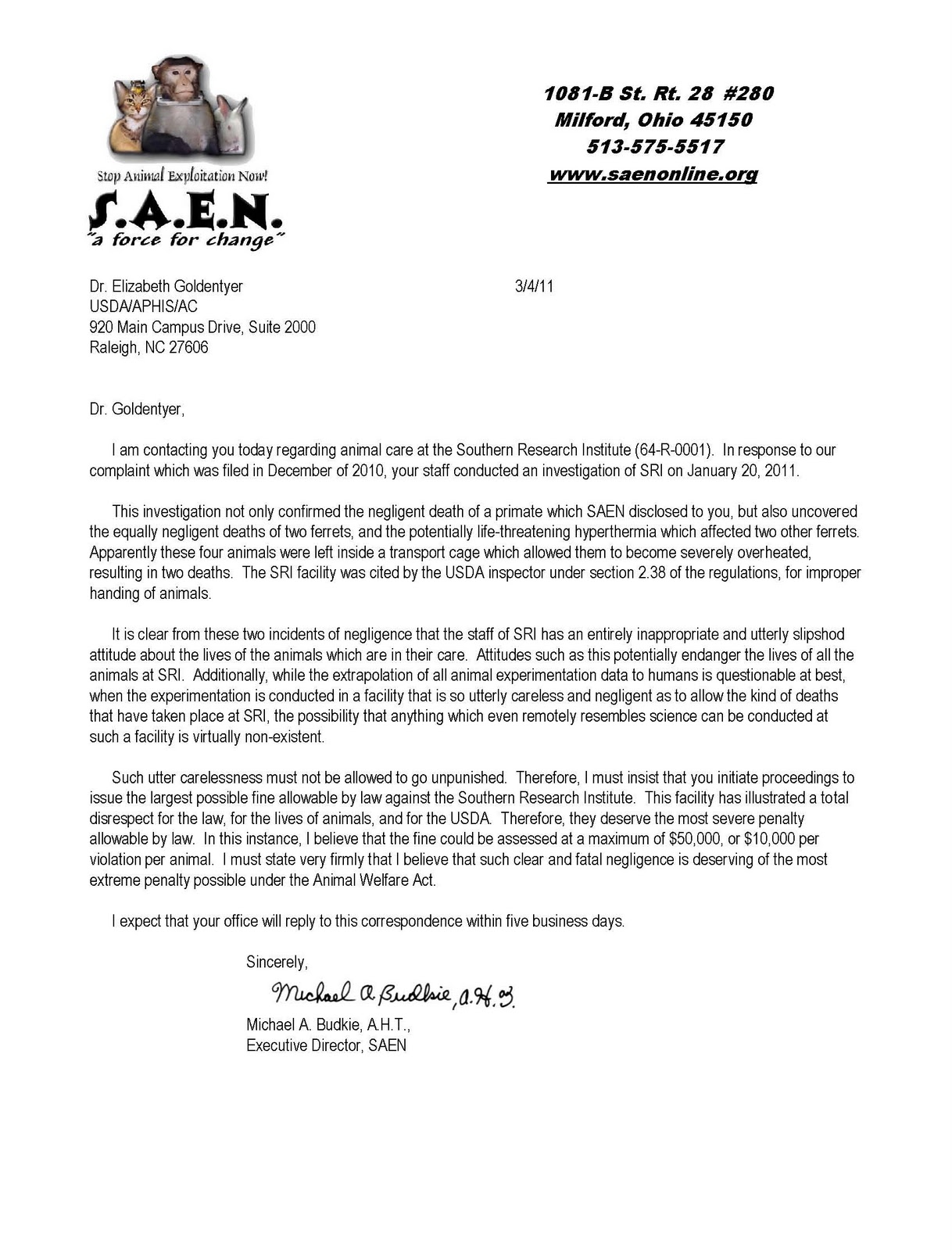
An animal rights group -- Stop Animal Exploitation Now! -- on Friday asked the U.S. Department of Agriculture to fine Southern Research Institute $50,000 for the deaths of a macaque and two ferrets, and the mistreatment of two other ferrets.

USDA veterinarian Michelle Williams investigated the death of the macaque in January after a December complaint by Michael Budkie, executive director of SAEN. His complaint charged negligence and inadequate care for two macaques, two cotton rats and one squirrel monkey whose deaths were self-reported by Southside-based SRI in its 2009 animal use report.

The subsequent USDA inspection report, dated Jan. 20, found that one of the macaques died of suffocation because safety clips were missing from or were unused on its cage, which allowed the monkey to poke its head out of the cage and apparently strangle. The report said corrective measures were taken to prevent that from happening again.

The USDA is still reviewing deaths of the other four animals listed in Budkie's December complaint.

But the USDA January inspection found another incident not included in Budkie's complaint: Four ferrets that were being carried from one building to another were left in their transport enclosure for two hours, far exceeding the normal limit of 45 minutes. Two died from overheating, and the others suffered hyperthermia but recovered.

The USDA inspection report says that SRI's Institutional Animal Care and Use Committee had investigated the ferret incident and found it was caused by employee error. That employee was put on probation and animal care employees got extra training. Again, measures were taken to prevent a recurrence, the inspection report said.

Budkie's Friday letter to Elizabeth Goldentyer -- a veterinarian who is regional director of the USDA's Animal and Plant Health Inspection Service -- asked for the maximum fine allowed by the federal Animal Welfare Act for mistreatment of the dead macaque and the four ferrets, $10,000 per animal.

"It is clear from these two incidents of negligence that the staff of SRI has an entirely inappropriate and utterly slipshod attitude about the lives of the animals which are in their care," he wrote. "Attitudes such as this potentially endanger the lives of all of the animals at SRI."

Keeping tabs

In a written response on Friday, SRI Public Relations Manager Rhonda Jung said, in part, that "we follow stringent reporting guidelines and regulatory agencies routinely inspect our facilities and practices. We place a high premium on animal care and safety, and try to anticipate and prevent accidents at all times.

"When there are unfortunate, unforeseen incidents, we are responsible in our reporting of them as required," she continued. "This matter has been investigated, and we consider it closed."

But Budkie said he hopes "the USDA will make an example of SRI to drive home the point that negligence that kills animals will not be tolerated."

Budkie is co-founder of the nonprofit SAEN, based in Milford, Ohio, and he keeps tabs on more than 1,000 U.S. animal research laboratories through use of public records.

Out of that number, Budkie said he files fewer than 20 complaints to the USDA each year.

"Without a complaint, the USDA may not even be aware the situation occurred," he said.

In fiscal 2009, Southern Research reported that it used 2,072 laboratory animals that are regulated under the Animal Welfare Act, including dogs, hamsters, rabbits, non-human primates, ferrets and cotton rats. About 1.1 million regulated animals are used in U.S. research labs or for instruction every year, Budkie said.
Excluded from the Animal Welfare Act are mice and rats -- which may make up 90 percent of all lab animals -- as well as amphibians and birds, Budkie said.

Each institution that uses laboratory animals for research or instruction has to set up a self-regulating Institutional Animal Care and Use Committee to oversee and evaluate that institution's animal care and use program.
Story Credit Here

Read the complaint, the USDA inspection report and Southern Research's response. below


An Ohio organization called Stop Animal Exploitation Now! has filed a complaint with the USDA over the deaths of some animals at Birmingham's Southern Research Institute.
USDA report on SRI incident complaint.


Found Here

S.A.E.N. complaint letter to USDA.


Found Here

Doing experiments on Chimpanzees is nothing but wrong!!!!!

I don't understand why the government can't just change the classification of Chimpanzees here in the US. Presently they are classified as "threatened" though wild Chimpanzees are classified as "endangered". When any animal is classified as "endangered" experiments are not permitted to be done on the animals. For example, Orangutans, Gorillas, and Bonobos are all classified as "endangered" and that's why no one is allowed to do experiments on them. If they would include the Chimpanzees is this classification than they also would not have to endure a lifetime of pain and suffering. It's that easy, just change the classification!!!!! So why hasn't the government done this yet? Because the government is the labs! We the tax payers pay for this abuse and it's time for the whole public to speak up, not just animal welfare and animal rights people, everyone needs to help!

Story;
A BATTLE by animal rights activists to save 14 chimpanzees from science and medical testing may well sound the death knell for all US medical experiments on the primates.

Rights and ethics groups led by the Physicians Committee for Responsible Medicine (PCRM) have seized on the case, which pits them against a powerful federal research agency, the National Institutes of Health (NIH), and revives debate the usefulness, as well as the ethics, of experimenting on humankind's closest living relatives.

Dallas doctor John Pippin, a PCRM senior adviser, said the NIH "acted unlawfully" in June and July 2010 when it transferred four female and 10 male chimps to a controversial laboratory in San Antonio, Texas, for use in invasive experiments.

Pippin and several other experts who are members of the non-profit PCRM filed a legal petition seeking immediate return of the chimps to their home at a non-research government facility in Alamogordo, New Mexico, where they lived with 186 other chimpanzees.

..Moving the animals "was arbitrary, capricious, an abuse of agency discretion, and in violation of the federal Administrative Procedure Act", Pippin told AFP in an interview.
The animals sent to the Southwest National Primate Research Center (SNPRC) are "old and sick," Pippin said. The research, he added, "is scientifically useless and also horribly inhumane".

The experts cite Rosie, a 29-year-old chimpanzee who was chemically immobilised 99 times by researchers in years of invasive experiments, as one of the 14 brought out of retirement and sent to Texas.
Chimpanzees have been used in research for decades, but many scientists have dismissed their usefulness in AIDS and malaria research, and their effectiveness in studies of hepatitis and other infections is in dispute.
After the European Union's 27 member states banned primate experiments last year, the US is now the only industrialised nation which has not done likewise.
Contacted by AFP, the NIH had yet to make a comment on the case as of late on Friday - but there are signs it is reacting to mounting pressure over the chimpanzees.

Activist groups and the then-governor of New Mexico, Bill Richardson, managed to convince NIH to suspend transfer of other chimpanzees from Alamogordo, according to Pippin.

NIH has agreed to await the findings of the independent Institute of Medicine, which has now launched what NIH acknowledged is "in-depth analysis to reassess the scientific need for the continued use of chimpanzees to accelerate biomedical discoveries".

It could take up to two years for the findings of the institute's study to emerge.

The PCRM notes the institute that oversees the Texas primate centre endorses primate studies involving "bioterrorism agents and other deadly pathogens" including Ebola virus and anthrax, in addition to work on AIDS and other infections.

Pippin and others insist the chimp research has no scientific value.
"The proof is that we don't have any hepatitis C vaccine, we don't have any AIDS vaccine, malaria vaccine," he said.

"We don't have an effective treatment for any of these diseases that have been studied on chimpanzees for decades."

But some researchers insist the experiments are vital, and vigorously defend lab research on animals such as mice and chimpanzees to advance medicine.

"We've made a lot of progress in research on hepatitis using chimpanzees," SNPRC director John VandeBerg told the Washington Post this week.

VandeBerg acknowledged that other developed nations no longer use chimpanzees for medical experiments, but stressed European societies "made a decision that was driven by animal rights advocates," and that European scientists still come to the US to do research on primates.

"They need chimpanzees just as badly as we do," he said.

About 1000 chimpanzees remain in US laboratories, including 500 at NIH facilities. Their number has decreased in recent years as breeding chimpanzees in captivity is now banned and importing them is illegal.
Story Credit here

A livetime of pain, loneliness, solitude, sickness and boredom is what Chimpanzees suffer in Government Labs

(Media-Newswire.com) - The last time Samantha Elaine Struthers saw her friend Lennie, he was hunched over, alone in a cage at an Alamogordo, N.M., research lab then known as the Coulston Foundation. The once warm, animated chimpanzee, whom Struthers had groomed and been groomed by many times, stared listlessly down through the bars, studying the bare concrete floor.
Because he had been infected with HIV, Struthers had to approach him wearing a white protective suit, gloves, goggles, a surgical cap, and a mask. Not until she spoke did he recognize her and show glimpses of the old Lennie—stomping his feet, banging on the cage, making buzzing noises. But, clearly desperate to escape his isolation, he also made uncharacteristic submissive gestures, grinning repeatedly and whimpering. Plaintively, he reached through the bars.
“It was really heartbreaking,” says Struthers, who on that day 14 years ago was director of behavioral sciences at the Coulston Foundation but now believes the animals’ social and psychological needs cannot be met in labs. “He’d be like my age, like around 50 now.… I never saw him on those lists that they said went to sanctuaries.”
Lennie never found his freedom; unbeknownst to Struthers, he died of a heart attack in 2002.

But in January, nearly 190 chimpanzees still at the Alamogordo facility got a reprieve with the help of former New Mexico governor Bill Richardson and others: The National Institutes of Health said the chimps will not be made available for invasive tests while an independent review of chimpanzee research is conducted.

Elsewhere in the U.S., about 800 other chimpanzees continue to languish in laboratories, even though they have proved poor models for research on human diseases and demand for them as test subjects has dwindled.
Struthers is among several hundred scientists and former lab workers who support efforts to end biomedical research on all chimpanzees, ban breeding to provide more chimps for labs, and retire the 500 federally owned animals to sanctuaries—where they would receive more humane care at lower cost to the government.
Seeking to codify these changes, The HSUS is working to get the federal Great Ape Protection Act reintroduced this year. In the previous session of Congress, the bill had broad bipartisan support. Many cosponsors were won over by a 2009 HSUS investigation that documented more than 300 alleged Animal Welfare Act violations at the New Iberia Research Center in Louisiana.

The HSUS also recently released records showing that the center was violating an NIH ban on breeding federally owned chimps—and that 14 infant chimps have been mauled to death since 2000, says Kathleen Conlee, HSUS director of program management for animal research issues. The HSUS is asking the government to investigate and immediately end taxpayer-supported breeding there.

Conditions at New Iberia remind Rachel Weiss, president of the Laboratory Primate Advocacy Group, of her mid-1990s experiences taking care of chimpanzees at the Yerkes National Primate Research Center in Atlanta. Ask Weiss why people should support the bill, and she tells the story of a chimp named Arctica, a veteran of vaccine and HIV research who had grown old and mean within Yerkes’ windowless confines, pacing about in her cage.
“She had steel gray hair,” says Weiss. “… She would grab you and try to scratch you through your gloves. She would spit in your face.”

Six years ago Weiss learned that the surviving chimpanzees from Arctica’s group had been released to Chimp Haven sanctuary in Louisiana. Weiss went to visit them, and there was Arctica, transformed: “She got up on the fence and she put her belly up to the fence. And she screamed, and she cried.… She was a whole different person.… She was dark. And she didn’t look mean anymore. She was happy.”

The Great Ape Protection Act would release hundreds more chimpanzees to finally enjoy a decent life. Show your support for the Great Ape Protection Act.
Story Credit Here

Thursday, March 3, 2011

Shame on you Capital One haven't you learned anything???????

For all of those that have a Capitol one credit card..... The interest you pay to this company is paying for them to use Chimpanzees in their advertisements which is NOT cheap and is to say the least... CRUEL.Not only do these chimps have to travel in small cages to get to their destiny, they are made to do actions over and over again with long stressful days doing things that they really don't want to do. Then the saddest part is that when this owner can't use this chimp for money anymore when it gets to big, where does that chimp go? These exhibitors that have chimps don't keep them around for 40-50 years feeding and housing them when they can't make money off of them anymore! Think about all of this Capital One when you think it's so cute to use them. SHAME ON YOU!!!!!

Story;
Despite recent controversy surrounding the use of chimpanzees in advertising, Capital One is airing a new commercial that features a chimpanzee "actor." Chimpanzees and other great apes used for advertising are typically very young animals who were forcibly taken from their mothers shortly after birth. They are often physically and psychologically abused during training to ensure that they will perform confusing, unnatural behaviors on cue. By the time apes reach approximately 8 years of age, they are too strong to be safely handled and are often discarded at wretched roadside zoos or other substandard facilities. Chimpanzees can live into their 60s, so life after "retirement" from the entertainment industry often means decades spent in appalling conditions.

The American Humane Association (AHA), which was reportedly on set during the production of the Capital One commercial, only monitors animals when they are on set and does nothing to prevent behind-the-scenes abuse and neglect. The AHA does not monitor pre-production training, the living conditions of animals, premature separation of babies from their mothers, or the disposition of animals when they are no longer useful to trainers.

Ten of the top 15 advertising agencies in the U.S.—including BBDO, Young & Rubicam, and McCann Erickson—now have policies in place that prohibit the use of great apes in their ads. In 2010, Dodge, Pfizer, Heartland Payment Systems, and Europcar pulled or modified ads that featured apes after learning about the ethical problems associated with exploiting these highly intelligent and sensitive animals.

Using the form below, please send a quick, polite note to Capital One and urge the company to follow the lead of other companies by agreeing to pull its commercial featuring a chimpanzee.
Story Credit Here

Wednesday, March 2, 2011

Emily Deschanel is fighting for the lives of 14 Chimpanzees used by NIH

She plays a forensic scientist on the hit Fox show “Bones,” but Emily Deschanel helps stop crimes in real life, too: the actress and animal lover is currently fighting for the lives of 14 chimps being used for testing by the National Institue of Health.

Deschanel sent the NIH a letter after learning that they plan to send 14 aging chimpanzees from the Alamogordo Primate Facility (a rehab and retirement facility for chimps used in testing) to the Southwest National Primate Research Center. The research center, based in Texas, has a “long history of animal abuse” according to Deschanel’s letter.

“Each individual chimpanzee has his or her own story,” wrote Deschanel. “As you know, their stories are all filled with pain and suffering. But you have an opportunity to give these 14 chimpanzees’ stories a happy ending.”

The chimps won a recent victory when the NIH suspended plans to move a huge group of 186 chimps from the rehab facility to the research center. However, the fate of the 14 chimps is still in question.

Deschanel’s strong support is no surprise: she has been heavily involved in animal rights cases in the past, is an outspoken vegan (along with her sister, “500 Days of Summer” star Zooey Deschanel), and even won the “Humane Advocate Award” from the Humane Society.

It’s great to see all of these stars standing up for chimps: Pamela Anderson and Woody Harrelson have recently written letters on the behalf of chimpanzees subjected to testing. With any luck, those 14 chimps will get to live out their lives in their home in New Mexico.
Story Credit Here

Monday, February 28, 2011

Backstreet Midland Restaurants have Chimpanzee Meat on their Menus

BACKSTREET Midland restaurants and market stalls are selling chimpanzee meat, the Sunday Mercury can reveal.
The sickening trade in bush meat has been exposed by a Government whistleblower, who says the chimp flesh was identified after it was seized by trading standards officials.

He told the Sunday Mercury: “It is well known this practice is underway in the region but I was shocked to discover the meat that was tested was once a chimpanzee.

“Dubious meat is often tested, and has turned out to be things like rats and vermin in the past – but chimpanzee is unbelievable.”
The chimp meat is understood to have been discovered after raids by trading standards in the Midlands.

The startling claims were last night backed up by British bush meat experts who outlined the shocking scale of the worldwide trade in dead wild animals, which stretches from Africa to the UK.

Dr Marcus Rowcliffe, research fellow at the Zoological Society of London, is an expert on the bush meat trade in Africa.

He recently completed an in-depth study into the smuggling of it through Charles de Gaulle airport in France, the hub of the trade in Europe.

It revealed that about 270 tonnes of illegal bush meat may be passing through the busy airport each year and out into the rest of the continent and UK.

Dr Rowcliffe said: “I’m not at all surprised that bush meat is on sale in the Midlands because we know the trade is going on in the UK and that there is a regular flow of smuggled meat into the country.

“However, it is not often that chimpanzee is found as that is rare even in the markets of Africa, so I am surprised by that.

“When we carried out our study at Charles de Gaulle airport, we estimated that five tonnes a week was coming into Europe and then being distributed across the continent by traders in Paris.

“Obviously I believe less than five tonnes a week makes it into the UK, but there is still a significant amount that is brought in and customs officials are very aware of it.

“What we do not know is exactly how it is distributed once it gets to the UK.

‘‘But from our work in France we discovered that the smugglers do not make much effort to disguise the bush meat, and quite openly take their chances trying to get into the country by bringing it in their suitcases.

“One man we found had nothing in his suitcase other than 50kg of bush meat.

“It is not on par with something like the drugs trade but there is clearly money to be made out of smuggling it and we know that it is associated with other underground activities.”

Bush meat is from wild animals hunted in places such as the tropical forests of West and Central Africa and is a tradition dating back centuries.
According to the Born Free foundation, nearly 7,500 tonnes of illegal meat products enter Britain every year.

Some is bush meat, brought in disguised as other meat products such as beef or lamb.

Once in the UK, more than half of the illegal meat is distributed through wholesalers or sold at local street markets.

The trade in bush meat has become big business and although accurate figures are difficult to come by it is estimated that overall the international trade in wild animal products has a value of more than £2.5 billion.

It has been claimed that a 4kg monkey would cost around £85 from smugglers in France, whereas the price would be as little as £4 in Africa.

But although some hunters target gorillas, chimpanzees and other primate species, great apes constitute less than one per cent of bush meat from all species sold on the market.

Dr Rowcliffe pointed out that the bush meat products were not just imported for consumption but also for medicinal purposes or as status symbols, signifying luxury and wealth.

But he warned that imported meat could be carrying infectious diseases such as foot-and-mouth, anthrax, the Ebola virus, TB or cholera.
The bush meat trade has also had a devastating impact on the numbers of primates living in the wild.

Adina Farmaner, Executive Director of the Jane Goodall Institute UK, said: “It is a reality that bush meat is being sold on the streets of Britain and I am not surprised that is available in the Midlands.

“From my own experience of Brixton market in London all you have to do is ask for some ‘special meat’ for a ‘special ceremony’ and you will get what you are looking for.

“The bush meat trade is a huge problem in certain parts of Africa and is one of the main reasons the population in the wild has been reduced from approximately one million about 50 years ago, to just a few hundred thousand today.”

Story Crefit Here

Friday, February 18, 2011

Research being done on monkeys by institutions like the UW are morally unjustifiable

UW brings in true monkey research foe, Dr. Lawrence Hansen
Bill Lueders on Thursday 02/17/2011

Last year, the UW-Madison beat back a Dane County Board resolution calling for an advisory panel to explore the ethics of primate research, much to the disappointment of local monkey defenders (see Rick Marolt's opinion column, 10/14/10). Instead, the university agreed to host a series of forums, which many predicted would be a bust.

But the first of those forums, set for Thursday, Feb. 17, at the new Institutes for Discovery, 7 p.m., presents a prominent critic of primate research. "I'm extremely pleased they have selected him," says local animal-rights activist Ann Emerson.

Dr. Lawrence Hansen, an eminent neuroscientist at UC-San Diego, finds much of the research being done on monkeys by institutions like the UW morally unjustifiable. Regarded as a leading Alzheimer's researcher, Hansen says most of the Alzheimer's research being done using primates is as pointless as it is cruel.

Last summer, Hansen wrote a letter in support (PDF) of the County Board resolution, saying this is an area in which the scientists involved are simply too biased to perform the necessary ethical assessment of their work.

Dr. Eric Sandgren, the UW's top overseer of animal research, says the panel that picked the speakers knows there aren't many "middle of the road" thinkers on this topic and thus is eager to present divergent views. "It's exactly what we wanted."

Dawn Crim, the UW's director of community relations, sent an email to County Board members touting the series, saying, "we hope you will come out and participate in the discussion."

Supv. Al Matano, the main sponsor of the failed resolution, notes the irony of that, since Hansen's speech Thursday conflicts with another event in his life: the regularly scheduled meeting of the Dane County Board.
Story Credit Here

Friday, February 11, 2011

Orangutans are being Mistreated by Indonesia Zoos

Yogyakarta. An animal welfare organization on Thursday called for orangutans at up to nine zoos across Java to be moved to wildlife rescue centers because of their poor living conditions.

Daniek Hendarto, an off-site conservation specialist at the Centre for Orangutan Protection, said only three of 12 zoos studied since April 2009 were providing their endangered apes with a decent living environment.
He said the study showed the orangutans at most of the zoos were housed in small, poorly maintained enclosures, were not properly fed and lacked even simple facilities such as a rope to swing on.

He also said the apes at these zoos are forced into “doing unreasonable things, like cycling or posing for pictures.”
“In fact, visitors to these zoos can easily mistreat the orangutans,” he said.

“These conditions cause the orangutans to fall into depression and are hardly going to help in educating the public about the importance of wildlife conservation,” Daniek added.

The zoos studied by the welfare centre included Surabaya Zoo, Malang’s Batu Secret Zoo, Lamongan’s Maharani Zoo and Taman Safari Prigen in Pasuruan, all in East Java.

In Central Java, they included Solo’s Taru Jurug Zoo, Kendal’s Wersut Sugini Recreation Park, Banjarnegara Zoo, the Romensy Recreation Park in Sukoharjo and Yogyakarta’s Gembiraloka Zoo.

The zoos in West Java and Jakarta were Ragunan, Bandung’s Tamansari Zoo and Taman Safari Bogor.

Of these, COP said only the Taman Safari parks and Maharani Zoo were treating their orangutans properly.

Daniek said the zoos should phase out the traditional closed cages and build more open enclosures with play facilities.
“They should also prohibit attractions such as photo ops with visitors,” he said.

“It’s possible to have attractions that can educate visitors and still amuse.”
Story Credit Here

Tuesday, February 8, 2011

PETA HELP!!!! Japanese restaurant makes monkeys have doll heads on and serve people

There are not enough words to say how very wrong this is!!!!!!. What in the world is wrong with people? Where are the laws for these monkeys? God what a horrible way to have to live. When you watch the video you can see that when the monkey is told something he/she is scared to death. I guess so if they do to these monkeys as they do with the other ones in the street with chain pulling hard on their necks. That story also found here on this blog under monkey owners. Just hired people for god sake. People can make their own choices.

Story;
By myFOXDetroit.com Staff
(WJBK) - There's some serious monkey business going on in a restaurant in central Japan.


We found a blog (complete with photos and video) explaining the experience at Kayabuki, a restaurant in Utsonomiya where monkeys are the servers.

The blogger claims the restaurant is a bit of the dive and the service was subpar... go figure. The creepy part of the experience to seems to be the human mask and wigs put worn by the monkeys.
Story Credit Here and a video

Monday, February 7, 2011

The investigation is in why some of the animals died at the Warner Park Zoo, not including Hank the Chimp

Well not only does the government torture our Primates, other countries abuse monkeys, chimpanzee breeders steal the moms babies, uneducated people buying chimps and monkeys, people making chimps do unnatural things, all for the sake of money. NOW we have an AZA Zoo that has been starving their animals!!!! What is this world coming to. First a zoo hires a convicted animal abuser to work around animals, now this! What's next? How do we draw the line? How do we make sure that the people are doing what they are suppose to be doing, which is caring, get it workers, CARING for the animals. How could anyone FORGET to feed animals when it is their responsibility to take care of them? They all need to be fired, especially the one in charge of the zoo!

I have 3 horses and one donkey and they go through one bale of hay per day plus get feed 2 times a day. Any moron knows how much to feed their animals. It's a shame they can't close this zoo down and transfer the animals somewhere else. They don't deserve to be open.

And they pretended they cared by giving Hank a funeral. Just a show, that's all. Hoping that people won't stop coming to their neglected animal zoo. How come there's no one checking up on these AZA zoos?
Those poor animals depended on those people for their lives and they disappointed them.

Thank goodness someone came forth that had worked there and told the truth. BTW that person lost their job, which I read in an article. Sure fire the person that really cares about the animals, not the ones that didn't take care of them!!!!

My thoughts are always this... People will ALWAYS let you down, but the animals won't!!!!!

Story;
The lack of proper care and feeding contributed to the deaths of four out of ten Warner Park Zoo animals according to a report by veterinary medical officer Suzanne Brunkhorst of the US Department of Agriculture. Two marmosets died when the animals were overlooked and not fed for two days. Zoo Director Darde Long stated it was an oversight by the zoo's management team, and everyone was deeply upset. The zoo is now in search of a licensed veterinary technician to ensure better animal care.

The investigation started with an anonymous complaint after the death of Hank, a 42 year-old chimpanzee and a zoo favorite. Several animals died within a one month time period including two newborn snow leopards freezing to death because their mother Kasmir was not able to get to the cubs. One cub inside the closure survived. The zoo staff denied even knowing the leopard was pregnant stating Kasmir showed no signs consistent with pregnancy. The zoo plans to appeal that complaint.

Also included in the investigation were observations of the 15 animals in the petting zoo. Records indicated the zoo ran out of hay on January 23, and the animals were acting "fussy without hay to chew on." The Department of Agriculture visited the zoo on January 26 and January 27. Authorities observed only one bale of hay which was not enough to feed 11 goats, 2 miniature horses, 1 camel, and a buffalo highlander cross. Zoo officials stated the animals were getting extra grain in place of the hay.

The three-page US Department of Agriculture report details recommendations and changes for the future care of the zoo animals.
Story Credit here
____________________________________________________________________

According to zoo officials, hank is now in Knoxville for testing to determine the cause of death. He showed no symptoms. And Sunday night Hank was just being Hank.
This information here


PETA Help.... Monkeys being tortured in Indonesia- Just horrible!!!!!!

Words can not express how horribly wrong and inhumane this is. These people that do this act like sewer rats! Go get a job, loser!  PETA needs to step in and somehow help these monkeys. What is wrong with people?

Story;
(All Pictures courtesy of Jakarta Animal Aid Network)

Fear and pain etched across his face, a little monkey cries out as he grabs helplessly at a metal chain biting into his neck.


As he lets out a high-pitched scream a gang of men force him to stand up straight, laughing as they tighten the chain.

It is just one of a series of shocking images of the hell the monkeys endure in the slums of Jakarta in ­Indonesia, where they are forced to walk upright and wear costumes… all in the name of entertainment.

A Sunday Mirror investigation discovered the monkeys are also made to wear masks, hats and glasses to catch the eye of ­passing tourists.

If a visitor stops, the monkey is ordered by its owner to walk on his hands, sit on toy rocking horses or ride bicycles in the hope the tourist will hand over some loose change.

Other creatures are forced to simply beg. On one Jakarta street a monkey was found wearing a doll’s head mask, her suckling infant clinging to her as she begged for money at the side of a busy road.


The disturbing images were passed to us by the ­Jakarta Animal Aid Network, which went undercover to expose the cruelty the monkeys endure.
Story credit Here and more photos

The truth behind Ham the Chimpanzee

I am so glad that PETA has decided to write this article. All I have been reading is about Ham the HERO? It's been in the new's now for a week and all have been fluff stories. Fluff stories do not tell the truth all of the time, or have hidden facts that aren't written or they just don't know the truth, the whole truth. Ham only lived to be 26 years old. Chimpanzees normally live to be between 40-50 years old. How sad and lonely was Ham, to have given up on life at such an early age? What a shame, what a crime, so so sad.Thank you PETA.

Story;
Fifty years ago this week, a young chimpanzee was launched into space on a suborbital flight that lasted just a little over 16 minutes. Chimpanzee number 65 was chosen from a group 40 captive chimpanzee candidates for the mission—one that left him crammed into a space capsule that would partially depressurize during its short flight.
While his flight was declared a success by NASA, it was preceded by months of pain and followed by years of lonely isolation for the baby chimpanzee, who was given the name "Ham" (after the acronym of the Air Force medical facility where he was cruelly trained) after his return.

What very few people at the time knew was that Ham had been captured in the jungles of West Africa by animal trappers and torn away from his family at the age of 2. He was subjected to 18 months of "training" in which he received electrical shocks to the soles of his feet when he failed to respond correctly in tests and had restraints placed on his neck, torso, and limbs for extended periods.

After completing his space mission, Ham was sent to the National Zoo in Washington, D.C., where this highly intelligent and social animal lived in lonely isolation for 17 long years. He was then transferred to the North Carolina Zoo, where he died at the age of 26—roughly half the life expectancy of chimpanzees living free in the wild.

That was 50 years ago, and you would think that NASA would have advanced beyond the archaic and fundamentally flawed science of cruel and irrelevant experiments on animals in its quest for space travel. Think again.

As recently as a few months ago, NASA was moving full steam ahead with a plan to blast dozens of squirrel monkeys with harmful doses of radiation. Then they would be isolated in cages and subjected to years of behavioral experiments in order to measure the damage caused by the radiation, which often includes cancer, loss of motor control, brain damage, and early death. But thanks in large part to a slew of PETA protests as well as e-mails and phone calls from PETA supporters and some high-profile support-including former NASA astronaut Leroy Chiao as well as April Evans, a NASA aerospace engineer who quit her job over the proposed plan—NASA grounded its ill-conceived scheme.

Besides the cruelty inherent in animal experimentation—whether the excuse is to test a new perfume additive or to conquer outer space—it is also bad for humans. That's because the often vast physiological and anatomical differences between humans and other animals renders the retrieved data dangerously unreliable.
You can mark the sad anniversary of Ham's voyage into space and keep the pressure on those responsible for cruel animal experiments by pledging to be cruelty-free and getting active for animals who are suffering in laboratories.
Story Credit here

Sunday, February 6, 2011

Noah the Chimpanzee who belonged to Gini Valbuena is in the superbowl commercials

Noah was born at the Sunrise Exotic Ranch Dripping Springs (recently sold their breeder chimps) approximately 7 years ago.

I was doing a set of commercials with my 2 chimps in Florida and the awful agent Bill Vergis mentioned to me about this woman Gini Valbuena, her site here. (OOOPS looks as though Valbuena has temporarlity taken her site down. You can check back later for that one, she'll put it back up.) Vergus had told me that she was selling her female chimp by the name of Kenya. I had done some research on her beforehand and knew of her history. A history of buying baby chimps and then getting rid of them at about the age of 6 years old. So we visited.

You can visit some videos here and please take notice of the names of the chimps. This is just in the past few years.

I had no idea she had a baby chimp but low and behold there he was laying on the floor in this encounter room she has.

Mikey didn't care too much for the baby and I was afraid he may hurt him so we moved out to her patio. My husband was with Louie, I with Mikey and Gini Valbuena with little Noah in her arms at about the age of 1 month old. She insisted that I hold him. My husband watched both other chimps and took a photo of me with Noah with my camera. The photos that are posted here belong to me and Gini Valbuena was well aware that they were being taken.

I held him for about 2 minutes and all of the sudden this horrible feeling came to me. I felt so bad for this little guy being ripped away from his mom. Reality struck, "I had done the exact thing with my 2 chimps." This was the beginning of my change of heart. I knew that this little guy, Noah would end up like all of the rest of the chimps Gini had owned, all over the place.


Notice in the photo that Noah has no hair on his face. Gini Valbuena always shaved their faces. The whole thing she does with these chimps is so sad for the chimps.

We visited with Kenya who Gini was trying to sell. I thought, um, if I can buy Kenya she could be with Mikey and Louie and have a permanent home with us instead of going god only knows where. I offered her 10K, not enough, 15K, still not enough. I asked Gini, how much do you want. She said that she wants to trade my little chimp Louie for Kenya. I couldn't believe what I was hearing!!! TRADE CHIMPS? You see, in Florida they have weight restrictions whereas they can't have encounters with chimps over a certain weight. Louie fell way below that because he was such a tiny chimp. She wanted to trade as though they were pieces of furniture and Kenya was an antique. Of course I said NO! My husband and I were out of there within minutes. This was the beginning of a battle between Gini Valbuena and myself that still lingers on to this day.

A few minutes later I went to the ladies room and still had my camera. On the way out I saw Noah laying in an old outdated crib, no longer allowed to be used for Human babies and took this photo. This photo belongs to me. Notice how his little leg and arm are stuck in between the bars of the crib. he was fussing so I went in and brought both his arm and leg back into the crib.


Valbuena sees nothing wrong with what she does. I, on the other hand feel as though this is one of the worst things you can do to a chimp. Love them like a Human baby, and then when you can't make any more money off of them, trade them in, get another one.  Gini Valbuena and Jeanne Rizzotto and some others ganged up on me after I placed my chimps. They made a horrible website full of lies because I, had seen the light. The light of the awful underworld of chimpanzees. I told the world, as I still do.

Now that you know how I first came into contact with Gini Valbuena, Noah's story continues......
You can see on this link, (woman with Noah is one of the Rosaires) that the next stop for Noah was the Rosaires of the circus see here that makes chimps ride horses, wear high heels chains around their necks. Notice how little Noah has a rope around his neck and his lips are tight together. This is a pouty face. I saw this with Mikey when I wouldn't give him what he wanted. Noah looks so sad!!!!

Now, this photo Here is at Steve martins place and please notice that Little Noah has a chain around his ankle and still has the pouty face.

The photos at the bottom of this page are of Noah and as the description at the bottom says Careerbuilders 2010.
Now where did Kenya go? The reason I went to Valbuenas in the first place. Kenya is residing at the Rosaires place (circus people). There was a short video on the internet that showed Kenya, Kira (another one of Valbuena's ex- chimps) and Noah, however it looks as though they have taken that down.

This is just one chimp's story and there are many more sad stories when it comes to chimps. They are tossed around to the highest bidder, made to do unnatural things and work, not have a normal chimpanzee structure of families, are bred and babies taken away, experimented on, and abused.


Noah at the age of 7 has already been taken from his mom, treated like a human baby, made to do unnatural things and work, has chains around his ankles and neck and is so sad for such a little chimp. If Noah was in the wild he would still be around his mom with her protection, her love, her teachings, but instead the next 40+ years of his life will be where? With who? doing what? Living how?

Here is another example of what type of person Gini Valbuena is;
DUIs
Published: Saturday, August 28, 2010 at 11:51 p.m.


Each person who is found guilty of driving under the influence of alcohol is sentenced to attend DUI school unless the license has been permanently suspended or revoked. Addresses listed are based on public records and may not be the individual's current address. The following is a portion of cases filed July 10-16.

Valbuena, Carol Virginia, 9732 Moore Road, Lakeland - license suspended 6 months, 12 months probation, $1309.36 fine.

This public information was found here

I find this ironic because she use to slander me by saying I was a chain smoking tattoo covered foul mouth bitch. Yes I have 4 tattoos, one is a monkey, one is a chimp, and the other 2 are flowers. There is no law against tatoos as there is with drinking and driving. Smoking, I have since stopped. Darn I really hope she didn't have the newest little chimp, Eli in the car with her. Looks as though Valbuena may have a drinking problem. Here is a link to a video where she had Eli in her arms at a winery while she was drinking. Notice in this video she has a real hard time answering the question of "where did he come from?" Does it sound like to you a big fat lie? It does to me.

So tatoos or drinking and driving. Um not a hard one.


Thank you readers.