The Little Rock Zoo

.The Little Rock Zoo needs to step up and care for the animals better! Please read the several artciles here with deaths, sickness and a bald chimp!
Showing posts with label experimental Labs. Show all posts

Friday, March 25, 2011

Sally Anne Ryan paints Chimps to raise money to help Cheetah from a former bio-medical research lab

What a talented artist and a good heart.


PRIMATE PIC: Sally-Anne Ryan
Again, Save the Chimps is my favorite!


A MONMOUTHSHIRE animal artist is fundraising to transport chimps to safer environments.

Sally-Anne Ryan, 37, of St Maughans, is raising funds for Save The Chimps to transport a chimp named Cheetah from a former bio-medical research laboratory in New Mexico to the world’s largest chimpanzee sanctuary in Florida.

This is after Cheetah was rescued by the charity from the Coulston Foundation laboratory where he had undergone 400 liver biopsies leading to him having three full blood transfusions.

It is legal to carry out testing on chimps in the US.

When he was rescued, Cheetah was found trapped underground in a cell nicknamed the “dungeon” with hundreds of other chimps.
It costs around $2,500 to transport each chimp which Ms Ryan has raised through painting pictures of the chimps at the sanctuary and giving the charity free copyright to sell the paintings. She also competed in the Reading half marathon at the weekend.

Although she has now raised $2,500 to transport Cheetah, who was the first chimp Ms Ryan painted a portrait of, she is still continuing the fundraising.

This includes helping with a Wales ape and monkey sanctuary appeal to have a chimp named Bili transported from a zoo in Bulgaria back to the UK.

This will cost £5,000 and Ms Ryan is offering to paint five pet portraits to the value of £200 each to help with the fund.

Anyone interested can visit www.gretalovesmabel.com or e-mail info@gretalovesmabel.com
Story Credit here

Friday, March 18, 2011

Research Labs are NOT where Chimpanzees belong- NIH

Dr. Hope Ferdowsian is director of the Research Policy Physicians Committee for Responsible Medicine:

Rosie was chemically immobilized 99 times by laboratory workers. The 29-year-old chimpanzee was finally granted a reprieve from testing in 2001, but the government recently moved her and 13 others back into laboratory cages. As a physician, I am concerned about the millions of dollars spent on decades of experiments using chimpanzees, which inflict untold pain and suffering upon these highly intelligent animals and have generally turned out to be a poor method of studying human diseases.

A few months after the 14 were transferred from Alamogordo, NIH granted 186 chimpanzees remaining at the New Mexico nonresearch facility a reprieve from further experimentation while the Institute of Medicine conducts an in-depth analysis of chimpanzee experimentation. But Rosie and her 13 companions remain at Texas Biomed, a controversial laboratory with a poor animal care record, where they have already been subjected to multiple liver biopsies and other procedures that require chemical immobilization.

The United States is the only industrialized nation still using chimpanzees for invasive experiments. I hope NIH will focus on modern methods that offer the most hope for human health —a nd allow these chimpanzees to live out their remaining years in the peace of a sanctuary.
Story Credit Here

Sunday, March 6, 2011

The Southern Research Institute is full of CRAP with their lies about animal welfare!

What a bunch of crap these people are at this research facility!!!! Please you say you care about the animals welfare. Well isn't it bad enough that you perform experiments on these animals and now you leave them in crates to die? Your so full of shit and so is the USDA. Remember folks the labs and the USDA work for the same organization....... OUR GOVERNMENT!!!!!

Story;
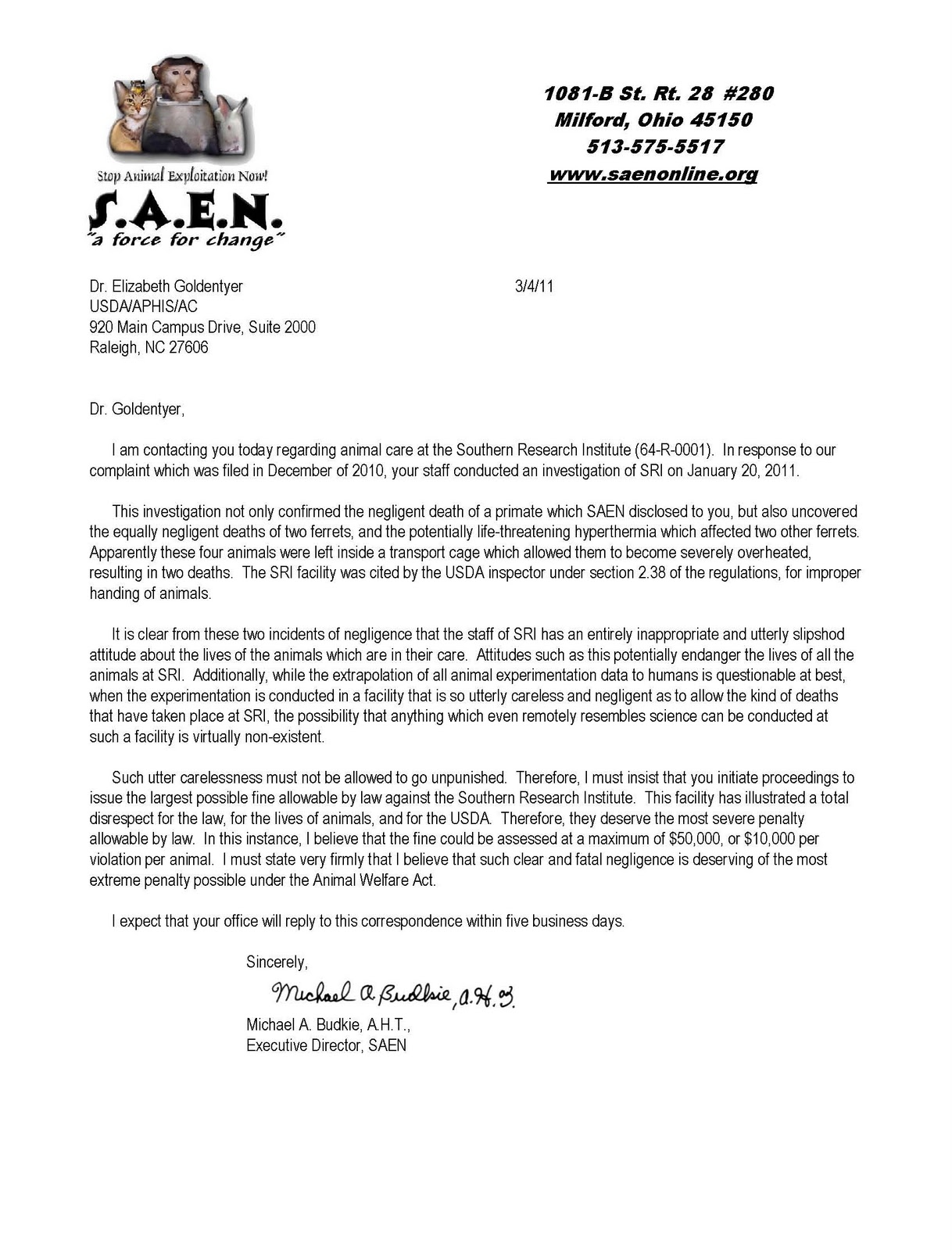
An animal rights group -- Stop Animal Exploitation Now! -- on Friday asked the U.S. Department of Agriculture to fine Southern Research Institute $50,000 for the deaths of a macaque and two ferrets, and the mistreatment of two other ferrets.

USDA veterinarian Michelle Williams investigated the death of the macaque in January after a December complaint by Michael Budkie, executive director of SAEN. His complaint charged negligence and inadequate care for two macaques, two cotton rats and one squirrel monkey whose deaths were self-reported by Southside-based SRI in its 2009 animal use report.

The subsequent USDA inspection report, dated Jan. 20, found that one of the macaques died of suffocation because safety clips were missing from or were unused on its cage, which allowed the monkey to poke its head out of the cage and apparently strangle. The report said corrective measures were taken to prevent that from happening again.

The USDA is still reviewing deaths of the other four animals listed in Budkie's December complaint.

But the USDA January inspection found another incident not included in Budkie's complaint: Four ferrets that were being carried from one building to another were left in their transport enclosure for two hours, far exceeding the normal limit of 45 minutes. Two died from overheating, and the others suffered hyperthermia but recovered.

The USDA inspection report says that SRI's Institutional Animal Care and Use Committee had investigated the ferret incident and found it was caused by employee error. That employee was put on probation and animal care employees got extra training. Again, measures were taken to prevent a recurrence, the inspection report said.

Budkie's Friday letter to Elizabeth Goldentyer -- a veterinarian who is regional director of the USDA's Animal and Plant Health Inspection Service -- asked for the maximum fine allowed by the federal Animal Welfare Act for mistreatment of the dead macaque and the four ferrets, $10,000 per animal.

"It is clear from these two incidents of negligence that the staff of SRI has an entirely inappropriate and utterly slipshod attitude about the lives of the animals which are in their care," he wrote. "Attitudes such as this potentially endanger the lives of all of the animals at SRI."

Keeping tabs

In a written response on Friday, SRI Public Relations Manager Rhonda Jung said, in part, that "we follow stringent reporting guidelines and regulatory agencies routinely inspect our facilities and practices. We place a high premium on animal care and safety, and try to anticipate and prevent accidents at all times.

"When there are unfortunate, unforeseen incidents, we are responsible in our reporting of them as required," she continued. "This matter has been investigated, and we consider it closed."

But Budkie said he hopes "the USDA will make an example of SRI to drive home the point that negligence that kills animals will not be tolerated."

Budkie is co-founder of the nonprofit SAEN, based in Milford, Ohio, and he keeps tabs on more than 1,000 U.S. animal research laboratories through use of public records.

Out of that number, Budkie said he files fewer than 20 complaints to the USDA each year.

"Without a complaint, the USDA may not even be aware the situation occurred," he said.

In fiscal 2009, Southern Research reported that it used 2,072 laboratory animals that are regulated under the Animal Welfare Act, including dogs, hamsters, rabbits, non-human primates, ferrets and cotton rats. About 1.1 million regulated animals are used in U.S. research labs or for instruction every year, Budkie said.
Excluded from the Animal Welfare Act are mice and rats -- which may make up 90 percent of all lab animals -- as well as amphibians and birds, Budkie said.

Each institution that uses laboratory animals for research or instruction has to set up a self-regulating Institutional Animal Care and Use Committee to oversee and evaluate that institution's animal care and use program.
Story Credit Here

Read the complaint, the USDA inspection report and Southern Research's response. below


An Ohio organization called Stop Animal Exploitation Now! has filed a complaint with the USDA over the deaths of some animals at Birmingham's Southern Research Institute.
USDA report on SRI incident complaint.


Found Here

S.A.E.N. complaint letter to USDA.


Found Here

Monday, February 7, 2011

The truth behind Ham the Chimpanzee

I am so glad that PETA has decided to write this article. All I have been reading is about Ham the HERO? It's been in the new's now for a week and all have been fluff stories. Fluff stories do not tell the truth all of the time, or have hidden facts that aren't written or they just don't know the truth, the whole truth. Ham only lived to be 26 years old. Chimpanzees normally live to be between 40-50 years old. How sad and lonely was Ham, to have given up on life at such an early age? What a shame, what a crime, so so sad.Thank you PETA.

Story;
Fifty years ago this week, a young chimpanzee was launched into space on a suborbital flight that lasted just a little over 16 minutes. Chimpanzee number 65 was chosen from a group 40 captive chimpanzee candidates for the mission—one that left him crammed into a space capsule that would partially depressurize during its short flight.
While his flight was declared a success by NASA, it was preceded by months of pain and followed by years of lonely isolation for the baby chimpanzee, who was given the name "Ham" (after the acronym of the Air Force medical facility where he was cruelly trained) after his return.

What very few people at the time knew was that Ham had been captured in the jungles of West Africa by animal trappers and torn away from his family at the age of 2. He was subjected to 18 months of "training" in which he received electrical shocks to the soles of his feet when he failed to respond correctly in tests and had restraints placed on his neck, torso, and limbs for extended periods.

After completing his space mission, Ham was sent to the National Zoo in Washington, D.C., where this highly intelligent and social animal lived in lonely isolation for 17 long years. He was then transferred to the North Carolina Zoo, where he died at the age of 26—roughly half the life expectancy of chimpanzees living free in the wild.

That was 50 years ago, and you would think that NASA would have advanced beyond the archaic and fundamentally flawed science of cruel and irrelevant experiments on animals in its quest for space travel. Think again.

As recently as a few months ago, NASA was moving full steam ahead with a plan to blast dozens of squirrel monkeys with harmful doses of radiation. Then they would be isolated in cages and subjected to years of behavioral experiments in order to measure the damage caused by the radiation, which often includes cancer, loss of motor control, brain damage, and early death. But thanks in large part to a slew of PETA protests as well as e-mails and phone calls from PETA supporters and some high-profile support-including former NASA astronaut Leroy Chiao as well as April Evans, a NASA aerospace engineer who quit her job over the proposed plan—NASA grounded its ill-conceived scheme.

Besides the cruelty inherent in animal experimentation—whether the excuse is to test a new perfume additive or to conquer outer space—it is also bad for humans. That's because the often vast physiological and anatomical differences between humans and other animals renders the retrieved data dangerously unreliable.
You can mark the sad anniversary of Ham's voyage into space and keep the pressure on those responsible for cruel animal experiments by pledging to be cruelty-free and getting active for animals who are suffering in laboratories.
Story Credit here

Sunday, January 30, 2011

Fifty years ago Ham the Chimpanzee went up in space

Fifty years ago, there was a space race -- a race the United States was losing to the communists.
Enter a hero, named Ham. The chimp would become the first hominid launched into outer space. And Ham wasn't just a passenger. He was taught to push a button once the light for re-entry came on. His mission set the stage for the one Alan Shepard would make May 5, 1961, aboard Freedom 7.


Marvin Grunzke of Montgomery, once an Air Force aeromedical specialist, holds a photo of Ham, the first chimp to be launched into space. Grunzke helped train Ham. (David Bundy Advertiser)

Monday is the 50th anniversary of when Ham the "astrochimp" launched into suborbital space inside a Mercury capsule.

And the chimpanzee's trainer, Marvin Grunzke -- a retired Air Force colonel and Faulkner University professor -- will dis­cuss his work and experiences Monday at Dalraida United Methodist Church.

"Nobody had been in space, so nobody knew anything," Grunzke said.

But at the time, John F. Kennedy had became president, and announced that the country would make "space our project," said Grunzke, 87, "and that we're going to the moon.

"What was significant about it was, we had just sent a missile up that had difficul­ty carrying a basketball-sized space lobe," he said. "So our capability for space was pretty dramatic."

In October 1958, Grunzke and his wife, Eunice, lived at Wright Patterson Air Force Base in Dayton, Ohio. Grunzke was working in an "unusual environments program," testing people and subjects in all types of environmental conditions.

One evening, Grunzke witnessed Sput­nik -- although he wasn't sure whether it was Sputnik, or Sputnik 2, which carried Laika, a Soviet space dog.

The dog became the first animal to or- bit the Earth and the first orbital death.

"They had enough missile pow­er to send that into space," Grunzke said. "And we didn't."

At that time -- the late 1950s -- there were only five people working in NASA, and they needed help. So the government approached the Air Force.

Grunzke was then an Air Force major and aeromedical specialist at Wright Patterson, and was request­ed by NASA to transfer to New Mex­ico to be a key trainer in the "ani­mals in space" program.

After Grunzke worked for a cou­ple of years to help develop training and data recording equipment and to train different animals, the chimp was selected and trained for space travel experimentation be­cause the chimpanzees share com­mon physical attributes with hu­mans.

But there wasn't enough power in the capsule to carry anything too heavy, so the chimp could not weigh more than 30 pounds.

It was an exciting time for Grunzke, whose design develop­ments -- including the chimp's chair, a restraint system, and even a pellet dispenser to hold treats -- took longer to complete than it did to train chimps, which only took a couple of weeks.

"They needed the chimps to have full movements, and only re­strained them at the knee and an­kles," Grunzke said. "We needed to assure the subject would respond, and reward them for good behavior.

"All of these things reflected the fact that we had to combine new technology and subjects new to us. We worked hard so we were able to stay ahead."

Grunzke said they developed two programs.

One, was a "continuous avoid­ance action" in which the chimp was required to continuously press the lever on a consistent basis.

"And they developed a nice schedule," he said. "They just sat there and kept pressing the lever. But another thing is ... we wanted to test to see if they had a good reflex response.

"So we developed another lever with a light over it, and it would come on in random intervals and the subject would have a quick time to respond. So they would be work­ing the right-hand lever on a con­tinuous basis and the left-hand le­ver would be on a single basis and (they) wouldn't respond to it except for when that light came on so we could test reaction times."

This helped researchers test their response time and their re­flexes. Both were important be­cause in both instances subjects were responding to avoid punish­ment. If needed, the punishment was saucer-type plates in the chimp's feet that would send a slight electric shock if needed.

They never failed.

"I don't have any regrets, be­cause I know that there were things we had to do," Grunzke said of the punishment possibility. "There were things we had to do for the be­havior to be maintained."

The researchers had to learn whether living things -- and even­tually a human being -- could han­dle the rigors of space, said Grunzke, a professor of physiologi­cal psychology and behavioral sta­tistics at Faulkner University for the past 15 years.

"We could see the subject was re­sponding, and working according­ly," he said.

At one point during the short mission, though, Ham experienced 16 forces of gravity -- now, astro­nauts experience only three to four forces of gravity.

"When you have that kind of force, we learned we could literally do this," Grunzke said. "It showed them that man could do this as well.

"Because of the similarity be­tween the chimp and the human, we could draw an extraction from that and show this could be a simi­lar situation for humans."

In the end, Ham's suborbital flight lasted 16 minutes and 39 sec­onds, and while the capsule he was in suffered a partial loss of pressure during the flight, Ham's space suit prevented him from suffering any harm.

"As a result of that, a kind of mis-programming of the Ham mis­sile, we were able to gain some very valuable information about what humans could or could not do un­der very adverse acceleration and deceleration issues," Grunzke said.

When first approached to help with the animal in space program, Grunzke was excited.

"If we stop to think about it, and you have to project yourself back to think about it -- (back then we didn't) even have the capability to send a grapefruit-sized (object) into space, and we were going to send animals into space," he said. "And they would be a precursor to man."

This was so exciting to Grunzke that he designed a program that demonstrated that animals could be trained to steer a missile.

"I did that because if we wanted to shoot a space flight to the moon, we would maybe have to steer the missile," he said. "The whole pur­pose was that we could steer a cap­sule into the atmosphere. The time­frame was such that we were just developing transistors. Everything that we did was on big relay racks" -- designed to program the sched­ules so he could switch and vary the schedule."

Grunzke considers himself gen­erously blessed.

"I always say I have been gener­ously blessed," Grunzke said. "There's not a whole lot that I did, but the Lord watched out for me.

"What we did was minimal things, but it opened the door."

After Grunzke worked for a cou­ple of years to help develop training and data recording equipment and to train different animals, the chimp was selected and trained for space travel experimentation be­cause the chimpanzees share com­mon physical attributes with hu­mans.
But there wasn't enough power in the capsule to carry anything too heavy, so the chimp could not weigh more than 30 pounds.

It was an exciting time for Grunzke, whose design develop­ments -- including the chimp's chair, a restraint system, and even a pellet dispenser to hold treats -- took longer to complete than it did to train chimps, which only took a couple of weeks.

"They needed the chimps to have full movements, and only re­strained them at the knee and an­kles," Grunzke said. "We needed to assure the subject would respond, and reward them for good behavior.

"All of these things reflected the fact that we had to combine new technology and subjects new to us. We worked hard so we were able to stay ahead."

Grunzke said they developed two programs.

One, was a "continuous avoid­ance action" in which the chimp was required to continuously press the lever on a consistent basis.

"And they developed a nice schedule," he said. "They just sat there and kept pressing the lever. But another thing is ... we wanted to test to see if they had a good reflex response.

"So we developed another lever with a light over it, and it would come on in random intervals and the subject would have a quick time to respond. So they would be work­ing the right-hand lever on a con­tinuous basis and the left-hand le­ver would be on a single basis and (they) wouldn't respond to it except for when that light came on so we could test reaction times."

This helped researchers test their response time and their re­flexes. Both were important be­cause in both instances subjects were responding to avoid punish­ment. If needed, the punishment was saucer-type plates in the chimp's feet that would send a slight electric shock if needed.

They never failed.

"I don't have any regrets, be­cause I know that there were things we had to do," Grunzke said of the punishment possibility. "There were things we had to do for the be­havior to be maintained."

The researchers had to learn whether living things -- and even­tually a human being -- could han­dle the rigors of space, said Grunzke, a professor of physiologi­cal psychology and behavioral sta­tistics at Faulkner University for the past 15 years.

"We could see the subject was re­sponding, and working according­ly," he said.

At one point during the short mission, though, Ham experienced 16 forces of gravity -- now, astro­nauts experience only three to four forces of gravity.

"When you have that kind of force, we learned we could literally do this," Grunzke said. "It showed them that man could do this as well.

"Because of the similarity be­tween the chimp and the human, we could draw an extraction from that and show this could be a simi­lar situation for humans."

In the end, Ham's suborbital flight lasted 16 minutes and 39 sec­onds, and while the capsule he was in suffered a partial loss of pressure during the flight, Ham's space suit prevented him from suffering any harm.

"As a result of that, a kind of mis-programming of the Ham mis­sile, we were able to gain some very valuable information about what humans could or could not do un­der very adverse acceleration and deceleration issues," Grunzke said.

When first approached to help with the animal in space program, Grunzke was excited.

"If we stop to think about it, and you have to project yourself back to think about it -- (back then we didn't) even have the capability to send a grapefruit-sized (object) into space, and we were going to send animals into space," he said. "And they would be a precursor to man."

This was so exciting to Grunzke that he designed a program that demonstrated that animals could be trained to steer a missile.

"I did that because if we wanted to shoot a space flight to the moon, we would maybe have to steer the missile," he said. "The whole pur­pose was that we could steer a cap­sule into the atmosphere. The time­frame was such that we were just developing transistors. Everything that we did was on big relay racks" -- designed to program the sched­ules so he could switch and vary the schedule."

Grunzke considers himself gen­erously blessed.

"I always say I have been gener­ously blessed," Grunzke said. "There's not a whole lot that I did, but the Lord watched out for me.

"What we did was minimal things, but it opened the door."

Story Credit Here and video

Saturday, January 15, 2011

Chimpanzees are still needed in research? BULL SHIT

If anyone has ever been to a big city in the poverty areas I think you will agree with me on this. I have seen many people starving on the streets of NY and Philadelphia, pushing around carts with small discards of what others don't want or can't use. Their hands are cold in the winter, they beg for money for food and you can tell that they haven't had a good meal or a bath in such a long time.

Why? Why can't these experimental companies approach these types of people and offer them a bit of salvation in return for testing? This would give them a warm and cool place to live, showers, food, and people that don't look down upon them. This way, the people have a choice, whereas animals have no choice in the decision that is made for them. People have the ability to say where something hurts or where they feel sick so that they can be given medicine to feel better, whereas Chimpanzees can not do that so they continue to suffer under these horrible experiments.

Yet, another idea is to use the criminals on death row to perform these experiments on. The way I look at this is that if they are on death row, they have nothing to lose except an extended life. What better subjects to use to find cures for humans, than humans.
STOP EXPERIMENTING ON ANIMALS THAT HAVE NO CHOICE, NOR HAVE THE ABILITY OF THE ENGLISH LANGUAGE!!!!! I TOTALLY DISAGREE WITH THIS ARTICLE!!!!!!!!!!!!!

Story;
We’ve discussed this before, but I think it bears repeating. Chimpanzees–because of their genetic similarity to us–still provide a crucial, albeit limited role, in medical research. For example, HIV is thought to have infected humans from chimps. But what kills us, rarely makes them sick. Finding out why is a matter of potentially tremendous life-saving benefit.

Story in full
This story is not even worth posting in it's entirety, though, I think the public should know how "some people" think.

Monday, January 10, 2011

Testing on Monkeys has provided a gel used in AIDS

SO.... Does this mean that they infected each one of these monkeys with the virus first? How horrible!!!!!

Story;
US researchers this week said the gel used an Aids drug along with a zinc compound and protected all animals tested from infection with the monkey version of HIV.

The results were published in the Public Library of Science journal PLoS ONE.

It "afforded full protection (21 of 21 animals) for up to 24 hours after two weeks of daily application," the researchers write. The gel uses a small amount of active drug and is both safe and cheap, said the Population Council in New York, which led the study.

The study joins a growing body of experiments that are beginning to show progress in preventing the spread of Aids.

Melissa Robbiani of the Population Council, who worked with the US's National Cancer Institute and other laboratories to test the gel, said the intention was to now start tests on people.

In July last year, researchers found that a similar gel, using the Aids drug tenofovir, reduced HIV infections in women by 39% over 30 months.

Nonprofit groups are also moving ahead to develop the gel, with the US Food and Drug Administration also wanting to fast-track its roll-out.

"It is like a positive domino effect," said Bethany Young Holt, director of the Coalition Advancing Multipurpose Innovations, a US women's health research and advocacy group and an expert on microbicides, gels, creams and other products that protect against infection.
Most infections with the Aids virus are in Africa and most new cases are among women infected during sex with men.

A microbicide could help protect against HIV while allowing a woman to get pregnant, and, if necessary, she could use the product without even letting her partner know.

"Just the idea of having a product that a woman could use to address the issue of unplanned pregnancy and sexually transmitted disease as well, that would be an enormous benefit to women," Holt said.

The product does not prevent pregnancy but researchers are working on a combined gel or a vaginal ring that will include a contraceptive.

The drug used in the Population Council product, MIV-150, was developed by Swedish company Medivir.

Like other HIV drugs, it blocks the virus from reproducing. MIV-150 specifically stops infected cells from spewing out new viruses.

MIV-150 is not available as a pill. The Population Council said this was an advantage because it would not reduce a woman's options for treatment later if she did become infected.
Story Credit here

Thursday, January 6, 2011

Project R&R's work to help stop experimenting on Chimpanzees

2011 is off to a hopeful start for 186 chimpanzees at Alamogordo Primate Facility (APF), who have been granted a reprieve from transfer to a Texas laboratory for use in invasive research.

According to a National Institutes of Health (NIH) statement issued yesterday, the transfer will be delayed “pending an Institute of Medicine [the health arm of the National Academy of Sciences] in-depth analysis to reassess the scientific need for the continued use of chimpanzees….” The report is expected to take about two years.

NEAVS/Project R&R and other national groups, including Animal Protection of New Mexico, breathed a sigh of relief at this decision, which came after months of urging the NIH to keep the chimpanzees in New Mexico. APF, a holding facility, does not conduct experiments on the premises, and the individuals now housed there have been spared from research for the past 10 years. NIH’s plan to move them to the Southwest National Primate Research Center to be readily available for invasive research provoked national opposition, including from New Mexico Governor Bill Richardson and other public figures.

Dr. Theodora Capaldo, NEAVS/Project R&R President, stated, “In the midst of national efforts to get all chimpanzees out of invasive research, this decision signals an important willingness on the part of our government to consider their policies toward chimpanzees in research at large.”

For chimpanzees like Flo, Danny, Heidi, Robbie, and the others at APF, the delay in the transfer is good fortune. Flo, the oldest chimpanzee at APF, is 53. According to Animal Protection of New Mexico, she has chronic weight loss, anemia, and cardiac arrhythmias. Flo gave birth to four children, all of whom were taken from her for research. All but one, Jojo — now 27 and also at APF — are dead.

While this halt to the transfer is promising, NEAVS/Project R&R will continue pressing NIH to permanently retire not only the Alamogordo chimpanzees but all those now held in labs. The Great Ape Protection Act, legislation which would end invasive chimpanzee research in the U.S. and release all federally-owned chimpanzees to sanctuary, had 161 cosponsors in the U.S. House of Representatives and six cosponsors in the Senate at the close of the 111th Congress.

NEAVS/Project R&R’s work, including reviews of chimpanzee use in human disease research, along with the work of millions of individuals and dozens of other animal protection groups and sanctuaries, is building steady progress for this legislation. Broad-based support for the bill comes from bipartisan legislative leadership and co-sponsorship, as well as animal protection groups, scientists, chimpanzee experts, celebrities, and the general public.
Story Credit Here
To take action to help these Chimpanzees and to thank Dr. Francis Collins, Director of the National Institutes of Health, for this wise and humane decision and to ask that NIH support the Great Ape Protection Act that is now before Congress. Here

University of Texas Medical Branch at Galveston has mutilated, tortured and burned animals, including isolating a monkey

This is a horrible horrible story. I have to wonder if these people that have done this to the animals even have a soul, heart or conscience! It really is a shame that our country doesn't have laws that say that once convicted of a horrible crime like this, the same things are done to them as they have done to the animals. I personally would like to get a hold of some of these people that have done this. Those poor animals to have suffered soooooo much before their death!  Do these idiots think that they feel no pain!!!!!!!  Imagine, if they have children and what they will become and how they are treated. What are they teaching the students that animals don't count!!!!! This is an awful crime of humanity!!!!!
Story-
Animals Mutilated, Burned at University of Texas Lab
Opinion by PETA

(16 Hours Ago) in Society / Animal Rights
A whistleblower at the University of Texas Medical Branch at Galveston (UTMB) has contacted PETA to report horrifying—and potentially illegal—abuses of dogs, sheep, monkeys, mice, and other animals who were tormented for experiments in the school's laboratories.

The insider reported that as a result of experiments in which dogs were cut open and had tubes surgically implanted in their colons, one dog died during surgery and another suffered in pain and died when staff members didn't provide post-operative painkillers.

UTMB experimenters also induced spinal cord and nerve damage in sheep, and in one instance, a sheep apparently couldn't stand for three days following surgery and was given no pain relief. Mice apparently died from dehydration, and a monkey was locked in a room all by himself, even though monkeys require social contact with other members of their species to maintain sanity and physical health.

In other procedures conducted in this hellhole, experimenter Daniel Traber subjected sheep, pigs, and mice to third-degree burns on up to 40 percent of their bodies by searing off their skin with a Bunsen burner or a scorching-hot metal rod and forced the animals to inhale smoke.

PETA has filed a formal complaint with the U.S. Department of Agriculture calling for an immediate investigation into these disturbing allegations. You can help by sending an e-mail to UTMB President David L. Callender urging him to investigate and discipline those responsible for abusing animals.

Written by Michelle Sherrow
Story Credit Here

Tuesday, December 21, 2010

NASA halts plans of radiation on monkeys

Who cares about MARS? We spent billions of dollars to step on the moon, where has that gotten us? An alternative to earth? NOT

Story
BROOKHAVEN, N.Y. — A NASA-run facility on the campus of Long Island's Brookhaven National Laboratory has halted plans for research on squirrel monkeys.

Newsday says animal-welfare activists and schoolchildren had opposed blasting the monkeys with radiation.

The proposed $1.75 million project was aimed at learning how a space voyage to Mars might affect the brain.
Full Story Here

Tuesday, December 1, 2009

End Animal Cloning

The Food and Drug Administration (FDA) moved in early 2008 to let animal clones out of the lab and into the grocery store, despite massive opposition from animal protection and consumer advocacy groups, Congress, and the dairy industry. The agency announced that it had completed its risk assessment, flawed as it was, and concluded that food products from cloned animals are safe to consume. The decision would allow milk and meat from cloned animals and their offspring to enter the food supply, without labels.

Food safety, however, is only one of the many issues that need to be examined before such a decision can be made. Scientists, for example, have repeatedly shown that cloning poses serious risks to animals, as the vast majority of clones suffer from severe birth defects, painful disease, and premature death.

Numerous ethical concerns have also been raised, and the majority of people have stated they are opposed to cloning animals for food and would not buy cloned foods even if they are ‘safe.’

Our government needs to consider the impact of cloning on animal welfare and the ethical implications before allowing this technology to move forward. But these questions have yet to be adequately addressed, much less resolved.

In a small sign that there is beginning to be an appreciation for the overwhelming public disapproval of animal cloning, the U.S. Department of Agriculture has imposed a voluntary moratorium on the sale of cloned animals, but not their offspring, for food while it examines the trade and market implications of introducing cloned animals into the food supply.

With our End Animal Cloning campaign, AAVS acts as advocates for farmed animals, educating the public about the animal welfare and ethical implications of cloning and seeking to keep meat and milk products from cloned animals and their offspring out of the human food and animal feed supply.

Animal cloning is cruel, experimental, and unnecessary. Just because we can clone animals for food, doesn't mean we should.


Take Action:

We encourage you to support our efforts. Please Explore the End Animal Cloning website to learn the truth about cloning for food and what you can do to get involved.

Source and a real eye opener

Types of Animal Research

Genetic Engineering Genetic engineering is the manipulation of the genetic code (the DNA, or genes) of a living organism. Generally, genes are removed (‘knocked out’), added (‘knocked in’), or altered to change their expression or function in some way. In the process, animals are treated as objects, their lives devalued, as they are manipulated at will by scientists.

The technology is used in most fields of research and can be divided into four fundamental areas of study: biomedical research, xenotransplantation, pharming, and agriculture production.

In biomedical research,
scientists genetically modify animals to study
basic biology and to develop artificial ‘models’
of human diseases.
In xenotransplantation research,
transgenic animals are engineered
specifically to produce organs, tissues,
or cells that can be ‘harvested’ and
transplanted into humans.
In pharming,
animals are genetically engineered
to serve as incubators or bioreactors
for the production of pharmaceuticals
for human use.
In agriculture production,
livestock are genetically engineered to
grow bigger and faster, produce leaner
meat, or be resistant to disease.
Transgenic animals are also produced
as pets.

Over the past decade, the production and use of genetically modified animals has increased tremendously. Since most of the animals used are mice and rats, who are not covered under the Animal Welfare Act, it is impossible to know exactly how many genetically engineered animals are used for such applications. It is estimated, however, that approximately 40 million genetically engineered animals are used worldwide just in the study of human diseases.

Despite researchers’ increasing interest in genetic engineering, animal health problems still consistently plague their efforts. Genetic engineering studies consume massive quantities of animals, and it requires hundreds to thousands of animals to create each ‘strain.’ Due to the unpredictability of the technology and frequent errors, a significant percentage of transgenic animals exhibit health issues and anatomic, physiologic, or behavioral abnormalities, causing significant animal suffering. Indeed, suffering is often inherent in the very design and purpose of the genetic modification.

Genetic engineering applications also raise concerns about human safety due to the risk of zoonoses, or the transmission of animals diseases to humans. These issues, as well as additional concerns about impacts on the environment from the escape or release of transgenic animals, the ethics of genetically manipulating animals, and whether products from genetically modified animals would be labeled as such, have yet to be seriously addressed.

To make matters worse, researchers use cloning to propagate ‘strains’ of transgenic animals. Cloning, like genetic engineering, causes tremendous animal suffering, and the combination of the two technologies takes an unprecedented toll on animal life.

In addition, researchers who ‘create’ genetically modified animals also typically seek patents on them. These patents cover not only the methods used to produce the transgenic animals, but also the animals themselves. Animal patenting, however, is highly unethical, treating complex, sentient beings as human inventions that are mere ‘articles of manufacture.’

Genetic engineering is an amazing feat of science, but it is fraught with serious and disturbing consequences. Not only does it represent one of the greatest threats to animals used in research, but it also has the potential to fundamentally change how humans view and use animals – for the worse. Researchers have an obligation to use this technology responsibly and ethically, and there need to be comprehensive regulations that ensure that animals, humans, and the environment are protected.

The golden age of biology should not be represented by the genetic engineering of animals, but rather by the harnessing of technological innovation for the development of non-animal models that will transform biomedical research into a more humane, reliable, and useful field of study.


Read more about animals used in Genetic Engineering:

"Genetic Modification of Animals in Biomedical Research: The science, the numbers, the cost", AV Magazine Winter 2004.
Peter Theran, VMD, discusses the questionable ethics of genetic modification, explaining how it compromises animal welfare, demands substantial financial support, and retards the soundness of society's core ideologies.


Other Types of Research:

Psychology Research
Military Research
Space Research
Genetic Engineering

Source