Well, this zoo is all excited about their "new feature", Oh goody more money from the visitors. They waited 5 years for him. Now he will be all alone without another Orangutan. If they had so much problem getting this one, how many more years will it be before they get another Orangutan so Tally doesn't have to live the rest of his life alone. What a shame, what a real shame. Also, even if they do get another one, who's to say they will even get along. I hope when the visitors come to see him they feel sorry for him, which is how they should feel. Put yourself in any animals life that has noone of it's own species, locked away, stared at, yelled at and see if that would make your life complete.
Story;
The wait is over! The Chahinkapa zoo has a new guest. Cages are prepped, people are trained, and the 5-year wait is over. The zoo has its first orangutan.
Talukan is a 24-year old Orangutan. It recently arrived here at the Chahinkapa zoo in Wahpeton. He's going through a re-adjustment phase so we couldn't video tape him. These pictures came from zookeepers.
The staff calls him Tally for short. His room has fire hoses, puzzles and hammocks. Zookeepers say he's extremely smart and their job is to actually find challenges for Tally.
"Things we would give Gibbon Apes or Spider Monkeys, who also are intelligent animals, but not nearly the intelligence of an Orangutan. What we would give them they'd take all day on. If we give it to Tally, he's going to have it finished in 10 minutes because that's how smart he is."
To give you an idea of just how strong orangutans are and how much they like to fiddle with things, the bolts in his cage had to be welded down otherwise he'd end up taking them apart. The zoo opens back up this spring and there will also be a welcoming tally celebration sometime in the summer.
Story Credit Here and Photo
Showing posts with label Orangutan Abuse. Show all posts
Showing posts with label Orangutan Abuse. Show all posts
Tuesday, December 21, 2010
Friday, September 25, 2009
PETA Speaks Out About R&R Partners
Saved by COP
Mother murdered by palm oil company
Orphaned by a palm oil company. Rescued by COP.

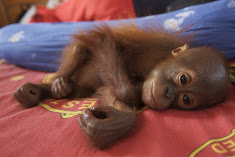
"Maeky" a one year old baby recently rescued by COP .
For Immediate Release:
September 24, 2009
Contact:
Kristie Phelps 757-622-7382
Las Vegas -- After reviewing information supplied by PETA--including a video narrated by film star Anjelica Huston showing that chimpanzees and orangutans used in advertising are removed from their mothers as infants and routinely abused in behind-the-scenes training sessions (trainers have been caught beating and kicking animals)--Las Vegas based advertising agency R&R Partners has promised not to use great apes in any future projects.
"Like human babies, chimpanzee and orangutan infants long to be with their mothers, not scared and alone in barren cages and abused on a hot, noisy set," says PETA Executive Vice President Tracy Reiman. "We commend R&R Partners for doing its part to stop animal abuse in entertainment."
Many trainers break these intelligent and strong-willed animals through beatings to force them to obey confusing commands and participate in frightening situations. At around the age of 8, when they grow too large to be managed, these animals--who can live to be more than 60 years old--are often discarded at roadside zoos or warehoused for decades in horrifying conditions.
R&R Partners joins Draftfcb, EuroRSCG, the Ad Council, Young & Rubicam, Levi Strauss & Co., Gap Inc., Subaru, Honda, Johnson & Johnson, Keds, PUMA, Yahoo!, SEGA, and other companies and organizations that have committed not to use great apes in ads.
For more information about PETA, please visit PETA.org.


Friday, September 11, 2009
What Palm Oil is Doing to Our Orangutans
The truth of the terrifying treatment of our wonderful Orangutans, filled with information and photographs.
Visit Here
Visit Here
Sunday, May 31, 2009
No Mums for Orangutan Babies

BUKIT MERAH, Malaysia (AFP) — A Malaysian orangutan sanctuary where baby apes wear nappies, sleep in cots and are cared for by nurses dressed in masks and starched uniforms has drawn the wrath of environmentalists.
At Orangutan Island in Malaysia's north, tourists snap photos as they file past large windows looking onto a facility billed as the world's only rehabilitation and preservation facility for the endangered primates.
Behind the glass, adorable baby orangutans like two-month-old Tuah lie swaddled in nursery sheets and cling to baby rattles.
"He is separated from the mother because his hands got entangled in the mother's hair and was unable to breastfeed," says the facility's chief veterinarian D. Sabapathy.
Tuah lies calmly in his cot with his eyes wide open and hands across his chest, hooked up to cables monitoring his heart beat and oxygen levels, ignoring the passing parade.
But the care lavished on the animals, which are fed every two hours by a staff of seven nurses on duty round the clock, is lost on environmentalists who say this is no way to treat wild animals facing the threat of extinction.
Managers of the 35-acre island, which is part of a resort hotel development, say they aim to return the animals to their natural jungle habitat, but so far none have been released.
"It is ridiculous to have orangutans in nappies and hand-raised in a nursery. How are they going to reintroduce the primates back in the wild," said senior wildlife veterinarian Roy Sirimanne.
Sirimanne, who has worked in zoos in Southeast Asia and the Middle East over the past four decades, said baby orangutans need to be with their mothers to learn survival skills.
"First, we need to save their habitat which is quickly disappearing. And it is the mother that will teach its young for the first four years or more on what to eat and how to look for food," he told AFP.
"Keeping the orangutans in captivity on an island is not a conservation programme. It amounts to desecration (of the species) as it is nearly impossible to reintroduce them back to the forest."
Experts say there are about 50,000 to 60,000 orangutans left in the wild, 80 percent of them in Indonesia and the rest in Malaysia's eastern states of Sabah and Sarawak on Borneo island.
But Orangutan Island is situated in the north of peninsular Malaysia, far from the jungles of Borneo where the orangutan's natural habitat is being lost to logging and palm oil plantations.
A 2007 assessment by the United Nations Environment Programme warned that orangutans will be virtually eliminated in the wild within two decades if current deforestation trends continue.
The Malaysian branch of conservation group Friends of the Earth said the best way to save the orangutan is to address rampant poaching and shrinking habitats.
"We are opposed to the orangutan sanctuary. We are opposed to this theme park resort having wildlife in captivity," said its president Mohamad Idris.
"Captive-bred orangutans have no natural resistance against diseases, making them susceptible to diseases. Death is inevitable," he said.
The centre's veterinarian defended the facility, situated in the tourist town of Bukit Merah, which opened in 2000 and now houses 25 orangutans.
He admitted the centre had suffered a high mortality rate in its early days, with seven deaths of infant orangutans between 2000 and 2003, but said it had learned a lot since then.
"It is the pride of Malaysians and it is aimed at helping ensure our orangutans do not become extinct," said Sabapathy.
He said the facility was originally stocked with orangutans obtained from the forestry department in Sarawak state on Borneo, who had been confiscated from individuals there.
"Now we can study the primate and collect data. The orangutans will eventually be returned to Sarawak. That is our objective," he said.
Sabapathy said infants were only removed from their mothers if they were underweight, neglected and at risk of dying, and that some mothers raised their own babies, including one born in May.
"I will not be disheartened by the criticism," he said. "We are not ill-treating them. People say the species is getting endangered but what are they doing? We are trying to increase the numbers in the wild."
Nearby, 21-year-old nurse Nadiah Mohamad smiled fondly at one-year-old April who was rejected by his mother, and fed him with formula while four-month-old June showed off by jumping around her cot and pulling the bedsheets.
"I love them. It is like taking care of a small child," she said.
When the baby apes are a year old, they are transferred to an "infant development unit" designed to teach them to live in the wild.
In another zone, enclosed with electrified barbed wire, adult orangutans are free to roam and build their nests in the treetops.
Most of the visitors, from Malaysia and abroad, are delighted to interact with the animals and are unaware of the criticism.
"I don't think it is wrong keeping them here. It is a practical solution to save the orangutans and educate our children," said 26-year-old Vikki Kendrick from Britain."
Tuesday, April 7, 2009
Clyde the Orang-Utan and Bobby Berosini
Do you remember Clyde in the movies with Clint Eastwood? How much we loved Clyde.
Video of Abuse
Video of Abuse
Video of Abuse
Video of Abuse
Friday, April 3, 2009
Orangutans in The Circus, Bobby Berosini
Emory University and Yerkes Regional Primate Research Center sold orangutans to night club performer, Bobby Berosini from 1973 to 1987. The television program, "Entertainment Tonight" aired a secretly-made video that showed Berosini beating the orangutans, night after night, about the head, neck and shoulders."
An Animal trainer that once owned Orangutans has items for sale of his circus videos and such. Before you buy anything from this website that pertains to Bobby Berosini the trainer, you should educate yourself on a "behind the scenes" video's of the treatment of his Orangutans before they made were made to preform.
Source
Source
Source
An Animal trainer that once owned Orangutans has items for sale of his circus videos and such. Before you buy anything from this website that pertains to Bobby Berosini the trainer, you should educate yourself on a "behind the scenes" video's of the treatment of his Orangutans before they made were made to preform.
Source
Source
Source
Wednesday, April 1, 2009
Bobby Berosini
Emory University and Yerkes Regional Primate Research Center sold orangutans to night club performer, Bobby Berosini from 1973 to 1987. The television program, "Entertainment Tonight" aired a secretly-made video that showed Berosini beating the orangutans, night after night, about the head, neck and shoulders."
Source
Source
Subscribe to:
Posts (Atom)